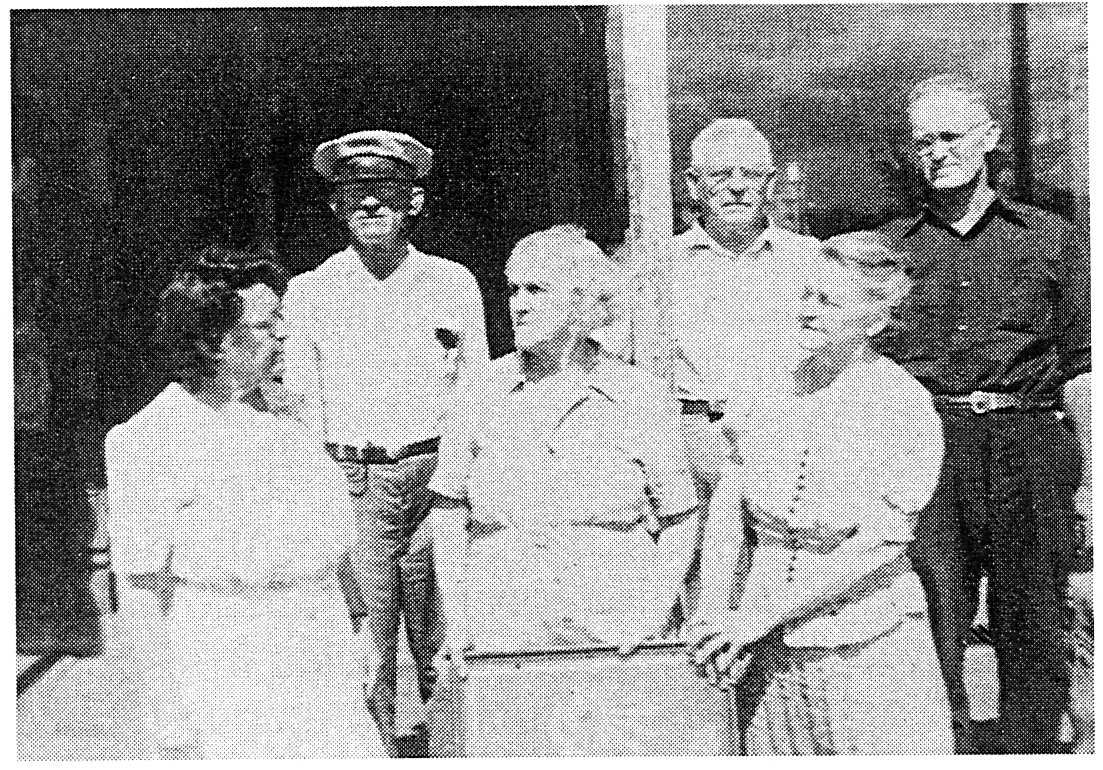
Ferdinand Heri was born at 9 P.M. in Horriwil, Kriegstetten in Switzerland on May 31, 1849[1] although the family later celebrated his birthday on June 10.[2] The Swiss birth register indicates that his father, Viktor, was a farmer from Biberist living in Horriwil. His mother was Maria Berni, from Deitingen.
Alma After Marriage
Ferdinand was two when his family left Switzerland to travel to the United States. There his family name would become “Harry” and his first name would be informally changed to “Fred.” One nephew would be given the middle name of Ferdinand in honor of his uncle.
As Fred grew older, he became involved in various family dealings, primarily in partnership with his older brother, John. The family in the United States began a rapid expansion, as Fred, John, and their three sisters, Clara, Mae and Louise, married and began families of their own.
Exactly how Fred and Carrie met is unclear. It is thought that they met at a dance. Carrie lived in Reed’s Landing and Fred lived in Iron Creek.
Fred was remembered as a “typical Schweitzer,” a kind and gentle man, never raising his voice. A quiet man, he never complained.[3] One of the positions Fred held in Alma was that of town fire chief. Although he never is remembered as bragging about the position, he had a number of wall plaques hanging up to honor his service.
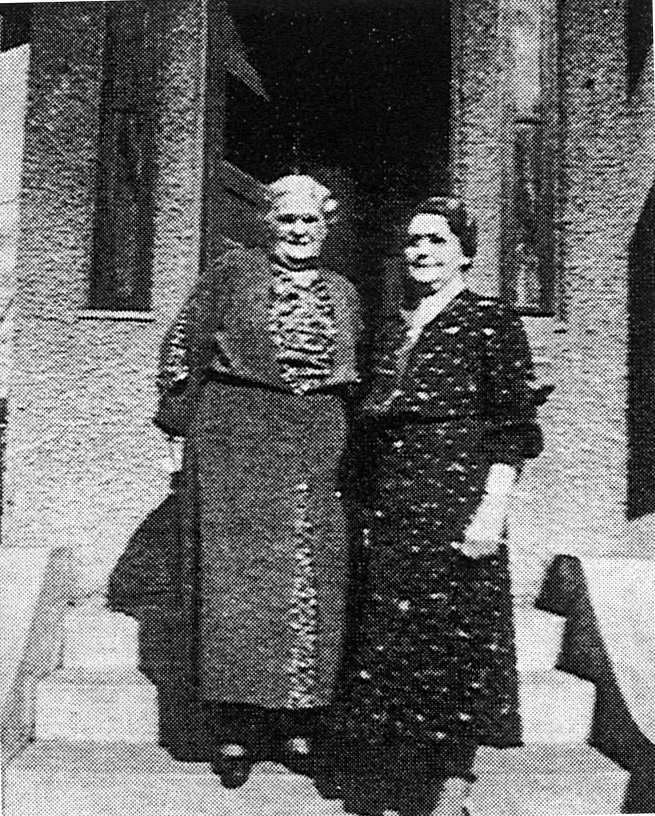
Fred was an expert log roller as he was quick and had a small stature. Log rolling was an essential skill to those who worked in the logging companies and the object of entertainment in the town on a lazy Sunday afternoon. Although an expert at log rolling, accidents did happen. Fred spent some time recovering from three or four broken ribs from one such slip up.
Caroline “Carrie” Wisemiller was a strong woman. Her firmness made her exceptional in child rearing. Her hands were never idle as she was expert at sewing, taking care of the sick and those in need, and even preparing the dead for burial. Many remember her as a born philosopher, always quick with a word of wisdom for all occasions.
The Fred Harry family initially lived with the John Harry family at 405 North Main. When the decision was made to open a grocery store on the first floor in 1885, Fred had a one and half story brick veneered house with full basement built for his family at 402 North Second Street, on the hill right above the Harry residence on Main Street. This second house freed up the space for the grocery store in the original building.
Once established on Second Street, the family continued to provide a “drop-in” spot for people passing through Alma who needed some assistance or maybe just a home cooked meal.
Sometimes Fred and Carrie were willing to give more than food and assistance. An African American family with about ten children came through town and stopped by the Harry’s. Because they received tremendous hospitality from Fred and Carrie, the husband asked if they could use “Harry” as their own last name. Fred quickly gave permission. Carrie and Fred even had a picture taken of the adopted Harry’s. This picture was placed in the family album and was among the family treasures passed from one generation to the next.[4]
Ara Harry
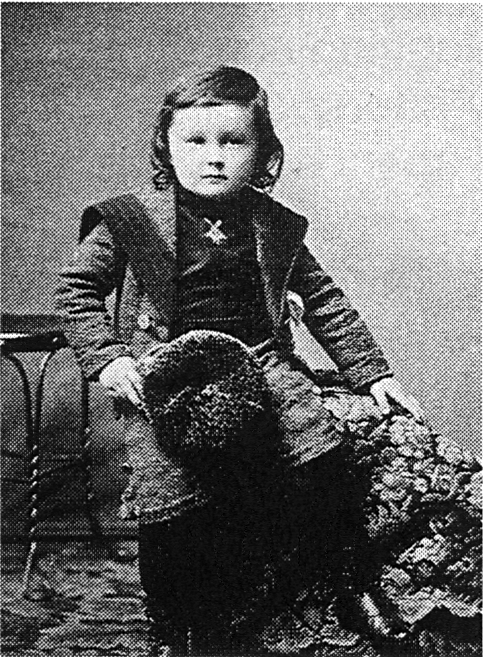
One day a lady stopped by Fred and Carrie’s house with a baby. She sat on Carrie’s bed and asked Carrie to raise him. The lady then walked out of the house and was never seen by Fred or Carrie again. The suspicion is that the woman had come upon hard times and that she was familiar with Carrie’s reputation for taking in people who needed help. She probably was secure in the knowledge that her baby son would receive loving care from the Harry’s.
Carrie and Fred welcomed the baby, Ara, as their own, eventually adopting him. The baby had been born on April 18, 1895.
Unfortunately, Ara developed appendicitis and died at the age of eleven on September 24, 1906 while the family was living in Verdon, S.D. He was buried in Conde, SD.
Eva (Evvie) Harry Family
Carrie and Fred’s first child was Eva, born March 12, 1876 in Alma. On the birth record, the baby’s last name is listed as “Herri.”[5]
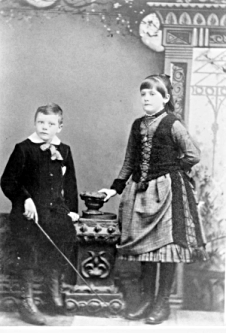
Known in the family as Evvie, she married George Carisch on June 15, 1899 in a ceremony in the Lutheran Church. George was a “popp (sic) manufacturer” residing in Hasting, MN. He had been born in Fountain City, WI., the son of Christopher Carisch and Annie Behlmer. The marriage was witnessed by Edmund Harry, Lena Carisch, Emil Carisch, and Lilly Weir. Performing the ceremony was the minister Frederick Wendt.[6]
Evvie and George Carisch had two children, Lyle George and Maurita. George and a couple of his brothers owned a farm in South Dakota. This began several migrations of the family to that area of the country. One farm owned by the family had 80 acres. The farming was so good that Roy and Lizzie Harry and Fred and Carrie decided to sell the property in Alma and buy more acreage in South Dakota. However, two years later the drought came and the bank foreclosed on the property. Fred and Carrie lived out the rest of their lives at 5125 Colfax in Minneapolis, MN, living with George and Evvie.
George and Evvie had bought the 80 acres in South Dakota as a source of income but never lived there. One of George’s brothers played baseball and he would send money home for the other brothers to invest. The Model T car in Spring Creek was purchased around 1916 by George and Evvie and given to Fred and Carrie.
George and Evvie’s son Lyle spent part of every supper at the farm in Spring Creek. In the summer he got a nickel to pull weeds around the corn field. He learned to drive a car during one of those summers. He remembers milking the cows and then having them go over the top of the bluff. Fred Harry would climb up there and get them– twice a day!
Lyle George married Wilma Nadine Braden on June 28, 1931. He attended Hamline University. A friend asked him to go to Wayzata, MN and build a theater. He knew a good banker who would provide the mortgage and so they built a theater in 1932. Over the years, the family owned theaters in Wisconsin, Minnesota, Montana, Colorado, South Dakota and North Dakota. When these were sold in 1988, they bought the Arby’s franchise in North Dakota and Montana. For a time, they also were in the medical transcription business, which was sold in 1997.
Roy Harry and Elizabeth Wirth
Roy Albert Harry was born at 3 A.M. on August 1, 1880 in Alma.[7] His wife, Elizabeth (Lizzie) Marie Wirth, from the Wirth family of Nelson was born on September 13, 1882 in Kansas. She was the daughter of Pennsylvania born Henry Wirth and German born Walburga (Bertha) Goettl. They married on September 5, 1910. Lizzie was the second of Bertha and Henry Wirth’s daughters to marry a Harry. Lizzie’s brother Ed Wirth and Roy’s cousin Louise Harry were witnesses for the ceremony conducted by the Rev. A. Schaenberg in Fountain City. Roy was 31 years old and a farmer in Verdon, S.D.[8]
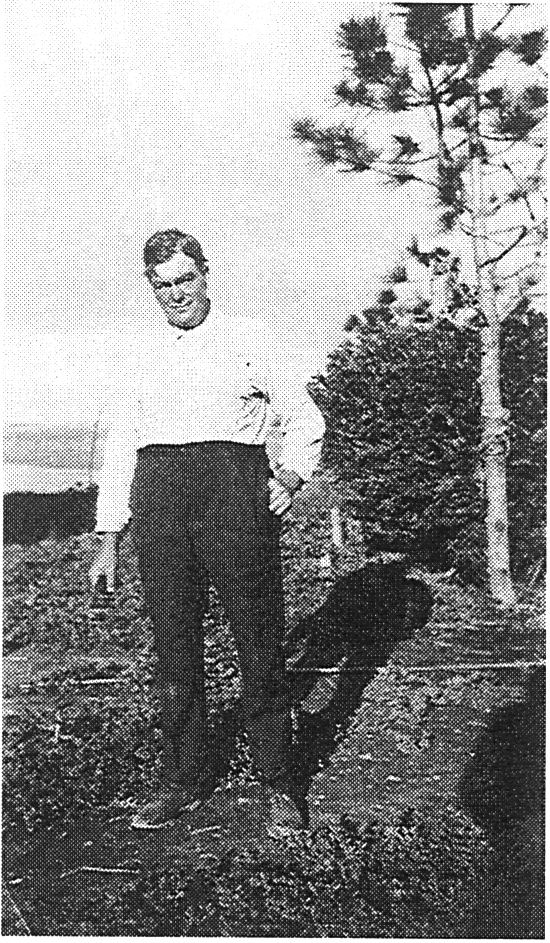
Roy and Lizzie lived on the family farm at Spink County, S.D. following their marriage. A daughter, Eva Beatrice, was born on July 19, 1911 in Verdon. However, in 1914, the family returned to Wisconsin, farming at Spring Creek where Roy’s parents were living at the time. Carrie’s two brothers had already moved back from the Dakota’s and so the Fred and Roy Harry families followed.
At Spring Creek, there was a great swing hanging from a huge tree and a playhouse which went beyond a child’s wildest dreams. Lyle Carisch built furniture for it. These were times when Eva would go out in to the woods and stay until mealtime. She would return to the woods as soon as the meal was finished. Other times she accompanied her grandmother to Mrs. Rupps and her wonderful ice box full of Green River and other flavors of soda pop. Or they might visit Mrs. Ruben and have strawberry ice cream.[9]
It was while living in Spring Creek that the family got their first Ford automobile. Roy and Lizzie asked Eva if she wanted the family to have a car or baby brother. “I chose the car as I was tired of riding in a surrey,” said Eva.[10]
When it came time for Eva B. to start school, the family moved into Alma, residing next to Nogle’s Saloon (operating as “The Dam View Bar” in the 1990’s). Eva attended grammar school, with Anna Smith as her teacher one year. Anna recalled Eva swearing when she didn’t get all of the flash cards correct.
The family did not live “in town” for very long but moved “out to the country” across the highway from the Miller Family in the same house where the Capp Family resided for many years. It was a brown house, next to the train tracks. It was here that Eva remembered receiving a visit from Santa Claus. She looked high and low for her mom to let her know that a special visitor was in the house, begging Santa to wait until she could find her mother. Unfortunately, it was only after Santa left that Eva B. was able to find her mom and tell her about the visitor.
These were active years. The Harry household was frequently full of visitors. Eva would accompany Roy to Modena or Durand or somewhere else to attend a funeral of someone he knew or to visit friends.
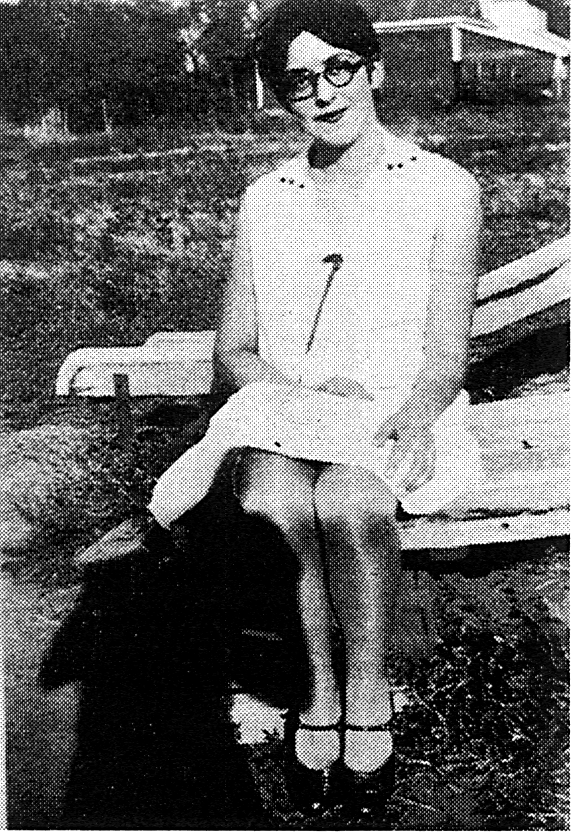
It was also during this time that Eva learned some important lessons from her parents. One of these lessons would be in honesty. Fascinated with the big match box full of broken crayons belonging to a classmate, Eva took them. Roy and Lizzie found out and on a Saturday, Roy took Eva to Ibach’s store for some new ones, as Eva thought he understood how badly she wanted crayons. She was allowed to select the colors she wanted from the crayon collection on the little round table in the store. However, when Eva started up the street to go home, Roy stopped her and said they were going to the school and replace the classmate’s crayons. Eva started to return the original broken crayons to the classmates but her father stopped her again and said the classmate would get the new crayons and she could keep the old ones. A hard lesson for a child but a lesson remembered a lifetime. Roy would later explain to Eva that he and her mother were afraid she would become a thief.[11]
One Spring, Eva got the mumps which was closely followed by the measles. This was followed by pneumonia. Then she had to have a rib resection. She was given the last rites of the Catholic Church as she was not expected to live. She was only ten at the time and in the 5th grade.
To this day she remembers having an “out of body” experience, only understood when others began talking about similar experiences in the 1970s and 80s. She remembers floating up to the ceiling and looking down on herself. She remembered finding Frank Harry standing at the foot of her bed when she came out of the ether.
During the late 50’s or early 60’s, Eva was once again in the hospital for one month. The surgeon was called in and in the course of conversation, he discovered that Eva had also been hospitalized in Wabasha at St. Elizabeth’s. It turned out that the surgeon’s cousin, a Dr. Bouquet, was at that same hospital. Dr. Bouquet had also married one of Eva’s cousins. The doctor returned frequently and he and Eva became good friends. He explained that she had carried the infection in her chest for 40 years. During this hospitalization, it was discovered that Eva was now suffering from bronchitis and emphysema.[12]
This first illness would force Eva to stay out of school for the remainder of the year. She recalls her father putting her in charge of the ducks. It was during this time that she learned another important lesson from her parents. The ducks were killed by a dog. Discovering the carnage, Eva began screaming. But her dad sat her down and explained that if you have something you might lose it. But even when you lose something, your life goes on. It was a lesson that would serve the little girl well in the not too distant future.
Her grandmother, Carrie, knitted her a cap and scarf. It was gray and pink with lots of fringe. However, someone at school stole them. Eva found out who took them and felt they should be returned. However, Carrie said to let the other little girl have them. She said the family probably did not have much because they were poor and the items would be used well. It would be another important lesson for young Eva.
Eva completed 7th grade in the one room schoolhouse at Iron Creek. In the fall of 1924, the family returned to South Dakota and remained there until 1926. Eva attended the 8th grade in a school house which abutted the family’s Groton, South Dakota property.
Death of Lizzie and Hospitalization of Roy
Lizzie had been sick the whole first year Eva was in high school with Addison’s Disease. This necessitated Carrie and Fred Harry moving to South Dakota in order to take care of Lizzie, the house, and a teenage Eva. In 1926, Eva’s sophomore year of high school, the decision was made for Lizzie to return to Wisconsin to be with the extended family. Eva recalls her father taking her aside after her mom drove away from the farm and explaining that she would not see her mother alive again.[13]
Louise and Charlie Radke accompanied Lizzie back to Alma. She stayed with her mom Bertha on the Nelson farm for one week, visiting with friends. The following week she entered the hospital in LaCrosse and within days she died. Roy’s cousin, Frank Harry and Frank’s wife, Lizzie’s sister, Mayme, had been with her at the hospital but had stepped out for some food. When they returned, Lizzie had died. Roy and his daughter Eva traveled to Alma for the funeral.
Shortly after Eva’s graduation from high school, Roy sat down with her and explained that he was sick and would not be able to take care of her anymore. He said she would have to be on her own and that he and Lizzie had brought her up to be honest and capable. He hoped she would always remember what they had taught her.
Roy remained at the State Hospital for the remaining 40 years of his life. He would frequently run away and the authorities would notify Carrie and Fred. It only recently became known that Roy was “escaping” to Ed Harry’s. He would remain there one week with Ed furnishing him tobacco and perhaps some new clothes. Then Ed would say “Roy, its time you go back” and Roy would return to the State Hospital in Yankton.
Eva remembered this period as the hardest part of her life. The visits to her father during the next four decades were frequent but always difficult. Her father was her favorite person. Between him and her grandmother, Carrie, she learned those important lessons that one does carry throughout life.
Eva– Teacher and Nurse
Eva was in Alma around 1930, attending the County Normal School while living with Russell and Anna Smith. They lived in a house on the hill above the Burlington Hotel at the northern end of town.
Eva’s first teaching job was in Chippewa Falls, WI at a school for mentally retarded children. Even though she hated the job, she stayed almost a year because she had no money for the trip home. While she did not enjoy this first attempt at education, there were brief periods of respite as she could visit cousins Keith and Margaret Wisemiller who lived nearby.
The year of teaching in Chippewa Falls was followed by several maid jobs in Minneapolis. There were only slightly more enjoyable than the teaching. However, an opening for something more interesting presented itself when the state medical hospitals offered training at no cost. The private hospitals were charging $80, putting them beyond Eva’s reach.
While pursuing the hospital training, Eva found a job taking care of four week old twin babies and their eleven year old sister. The children’s father worked as a gardener for a rich family in Minneapolis. Their mother was confined to bed with a double mastoid. Eva received $2 a week and generally spent that on milk for the twins. The depression was on and no one had money. Most evenings were spent walking the floor with cholic babies and days were filled with trying to stretch the groceries.
In 1934 Eva entered the nursing course at St. Peter’s, a state hospital. She received a stipend of $35 a month, three squares a day, and generally was relieved of worries about money. St. Peter’s was affiliated with the Ancker Hospital and the Children’s Hospital in St. Paul.
It was while at St. Peter’s that Eva met Vic Kasel, a railroad man. She immediately had a crush on him and they went together for awhile. There were some problems however. Vic wanted to get married and Carrie had told her granddaughter to finish her training before marrying. Also, Vic liked his drink and was slightly tight with the money. Eva grew tired of eating the hospital diet and Vic never seemed willing to spring for even a hamburger, even though they had met at a hamburger stand.
Some 50 years later, Eva mentioned to a cousin, a railroad employee, that Vic, her former boyfriend worked at that same railroad. As fate would have it, Vic now worked in the office next door to the cousin. While Eva was visiting the cousin’s house, Vic and his wife stopped by. Eva noted that he still drank whiskey, chasing it with beer. But the Hollywood ending was not complete. It seems that Eva and Vic’s wife had also crossed paths early on. Vic’s wife remembered Eva as the student nurse from Ancher Hospital who was noted for stretching the hospital rules.[14]
Around this time, Carrie, Eva’s grandmother, began experiencing illnesses. Evvie Carisch called Eva to come to Minneapolis because she was able to handle Carrie better. Eva returned to St. Peter’s, the state hospital, and stayed until 1940. From 1940 until 1942 she worked as private duty nurse in Minneapolis and then worked as a general duty nurse, for six months at the University hospital.
When her grandmother Carrie died in October of 1940, Eva was quite ill in a Rochester, MN. hospital. She was unable to attend Carrie’s funeral as the doctor warned “there would be a second funeral.”
With her grandparents both dead, Eva went out west with a hospital friend, Viva Cash and her husband. They traveled in a one seat car with the Cash’s eight month old baby. Arriving at Olympia, WA., Eva was dismayed to find only Catholic hospitals. She did not care to work in religious hospitals because the nuns scared her.
Taking a bus to Seattle, arriving in a rainstorm about 2 P.M., Eva applied at a hospital and was passing out trays by 5 P.M. She set up residence in the nurses’ lounge for three days until the hospital found her a place to stay. As pleasant as the people were, the climate was as disagreeable. She developed strep throat and began experiencing other medical problems. The doctor told her she would have to find a more hospitable climate. She settled on Phoenix, AZ. where her friend Ann Mead lived. However, the Phoenix climate was the other extreme. So in 1943 Eva was grateful to receive an invitation from her cousin Anna Smith to come to San Diego.
Following D-Day, the Smith’s returned to Wisconsin and Eva hooked up with another friend, Idella Ashworth. However, when Idella’s mother got ill she had to return to Oklahoma but asked Eva to come work for her there. She worked in nursing and needed someone she could depend on to help her. Eva would spend four years in Oklahoma.
However, when her cousin Rosemary died of tuberculosis on May 30, 1948, Eva headed back to Alma. She left again for San Diego, this time traveling with Anna Mae Radke. She took employment in the nursery at Hillside Hospital.
But Eva felt some restlessness and decided to apply to various Catholic convents for admission. Her early uneasiness with Catholic nuns seems to have abated. Although she applied to several religious orders, she was accepted into the Carmelite Sisters of St. Theresa of the Infant Jesus in Oklahoma City, OK. This particular religious order of women worked as teachers in parish grade schools throughout California and Oklahoma and ran a home for the mentally retarded in Oklahoma City.
In 1955 Eva traveled back to Oklahoma to join the convent. She spent the next ten years as “Sr. Pierre.” The first five years were spent at the motherhouse. Her second year of novitiate, Eva was sent to work in a nursing home. The following three years, she taught in the Indian School in Fairfax, OK. and the Mexican School in Oklahoma City, OK. In 1960 Eva went to Riverside, CA to teach first grade at Queen of Angels, which she did for six years.
In 1966, at the age of 54, she made the decision to leave the convent and went to work at Camarillo State Hospital, just north of Los Angeles, CA. She retired on disability when she was hurt her back lifting a patient and moved to San Diego, near the Smith family.[15]
Death of Fred and Carrie
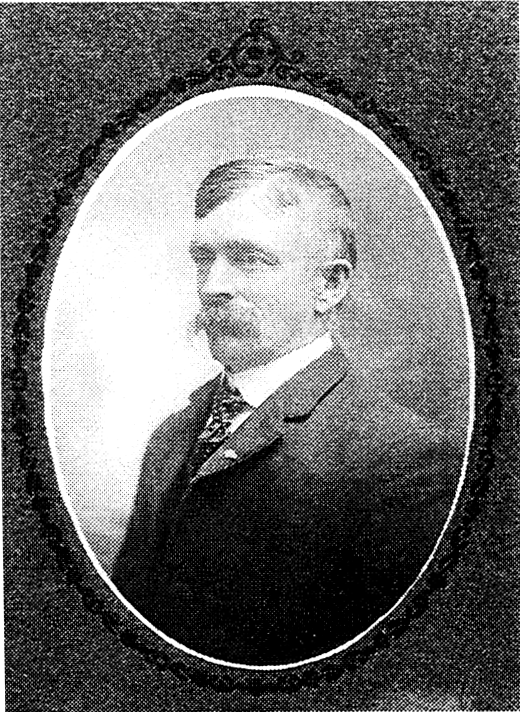
Fred died on September 1936 in Minneapolis, MN. at the age of 87. He was sitting in his bed and just slumped over in his wife’s arms and died.
Carrie died in October 1940. She had asthma all her life and heart trouble. Both were buried next to Fred’s parents, Victor and Maria, in the Alma Cemetery.
Death of Roy Harry
Roy Harry died at the State Hospital in Yankton, South Dakota on February 12, 1966. His daughter Eva had just received her first paycheck after leaving the convent. It came just in time for her to forward it to the South Dakota funeral director to take care of her father’s funeral. Eva had always been concerned that her father be baptized Catholic and she was relieved to find out that Roy had converted to Catholicism on his death bed. She was subsequently relieved of an additional $25.00 of her first pay check for the priest’s services. It was a price she recalls being more than willing to pay though, knowing that her father had died in peace.[16] Roy was buried in Yankton, S.D. in Sacred Heart Cemetery.
Footnotes
[1] Auszug dem Beburts-Register (Old Volume). Copy of information contained in Birth Register.
[2] Fred’s granddaughter, Eva B., points out that government certificates are not always accurate. On her birth certificate, her father is listed as LeRoy (should be Roy) and her year of birth as 1910 (should be 1911). The certificate also lists her birth as a boy.
[3] Letter to author from Eva B. Harry, dated May 8, 1983.
[4] Phone conversation between Eva B. Harry and author.
[5] Buffalo County (Wl) Birth Records, vol 2, 52.
[6] Buffalo County (WI) Marriage Registry, vol 3, 255.
[7] Buffalo County (WI)Birth Records, vol 2, 152. While the family held 1880 as the year of birth, the certificate records it as 1879. See footnote 106 for further discussion of discrepancies on official documents.
[8] Buffalo County (Wl) Marriage Registry, vol 5, 300. License # 95 issued on August 30, 1910.
[9] Letter from Eva Harry to Fred and Ruby Schwaab dated February 6, 1982.
[10] Letter from Eva Harry to author dated August 16, 1995.
[11] Letter from Eva Harry to Fred and Ruby Schwaab dated February 6, 1982.
[12] Letter from Eva Harry to Fred and Ruby Schwaab dated February 6, 1982.
[13] Letter from Eva Harry to Fred and Ruby Schwaab dated February 17, 1982.
[14] Phone conversation between Eva B. Harry and the author.
[15] Letter from Eva Harry to Fred and Ruby Schwaab dated March 2, 1982.
[16] Letter from Eva Harry to Fred and Ruby Schwaab dated March 2, 1982.