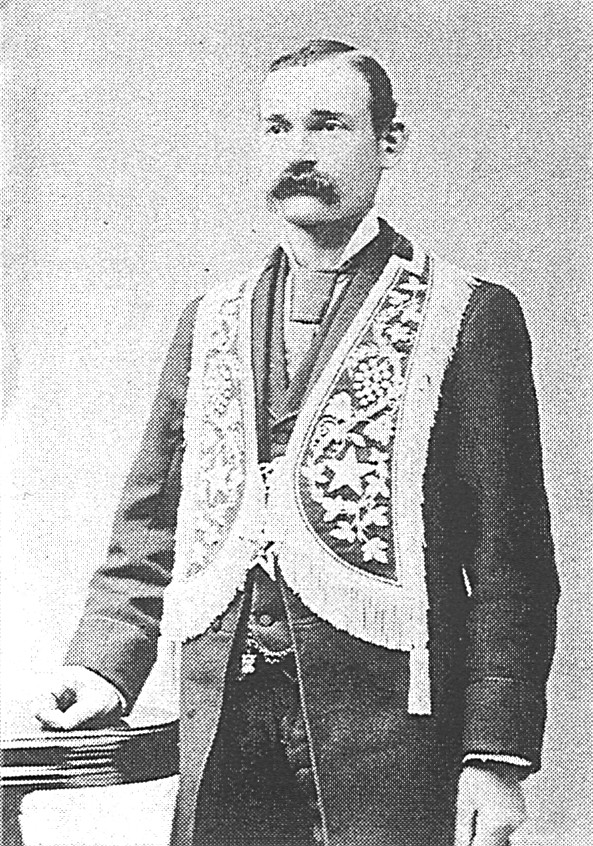
Michael and Annie Kirchen Biewer immigrated to the United States of America from the small European country of Luxembourg. The voyage was said to have taken three months but it was more likely three weeks. The family settled on a farm at Fredonia, Ozaukee County, Wisconsin, which is near Milwaukee. Annie had been previously married and left a widow with one young son, Nick Komas, Jr. Her later marriage to Michael Biewer produced five children, Mary, George, Frank, Nick and Annie.
These early days in the United States were wrought with difficulty. Since the family did not have any horses and oxen were too slow for transportation, they would walk the six miles to Holy Cross Church and after the service, they would walk back. A neighbor, Grandma Becker, carried Annie the six miles to and from church in order for her to be baptized. Several of the Biewer and Becker children intermarried later.
Michael Biewer was a shoemaker. Cows were vital animals but very scarce and so when the Biewer’s cow had the misfortune to break her leg, Michael used his knowledge of shoemaking to make a peg leg or splint for the cow. With the artificial leg the cow got along quite famously, even going to the pasture. After some time the leg healed and the cow was saved.
Nick Komas, from Annie’s first marriage, was in the artillery during the Civil War. No records on Mary Biewer could be found. Family tradition holds that it was Mary and her husband who rescued the teenager Annie from the bad situation in Milwaukee where she had been sent to work following the death of their mother.[1] The only mention of Frank Biewer was in George’s pension records. George’s wife mentions her brother-in-law Frank in her records.
George Biewer (1843-1890)
George Biewer was born in 1843. He married fifteen year old Elizabeth (Lisette/Lizette E.) Schink on November 10, 1865, four months after he was discharged from the army. George had known his wife’s brother Henry and probably the whole Schink family long before he left to enter the military. They lived ten miles apart in Wisconsin.
The marriage ceremony was performed by Justice of the Peace Edmund Janson at Port Washington, Wisconsin. Information from the “Familien Register” section of the family’s German language bible lists children John W., born on April 23, 1875 in Middletown, Jackson County, Minnesota and William H., born on November 22, 1879 in Middletown. Another record shows the children’s birthdays as April 14 and November 2 respectively. Government records show one daughter, Julia Biewer, born around 1873.
The children were sick with measles and pneumonia. Four children died in 10 days. Julia, who lived, was the only child who did not take the medicine given to her but hid it instead. Those who took the medicine died. One of the girls went into a trance and they thought she was dead. While she was in this trance, her brother Frank died. She did not know he was dead. When she came out of the trance, an before she died, she said, “We never knew how Frank could sing. But you should hear him now.”[2]
George was a farmer. Lizette had a reputation “among some of her acquaintances of having a somewhat sharp tongue but her reputation otherwise is unquestioned.”
George enlisted on October 2, 1861 in Charles Boegers Battery #2 of the Wisconsin Light Artillery in the Civil War.[3] According to family tradition, George, was stepped on by a horse and hurt. Because of his injuries, he was later stationed as a prison guard. He was discharged on July 10, 1865 at Milwaukee, Wisconsin. Government records show the injury took place while George was on duty at Point Lookout, Maryland on or about January 1, 1865. Brother-in-law Henry Schink said George “was in heavy artillery and in riding one of the horses he was thrown off and one of the wheels ran over his shoulder.” The affidavit of Max Bergniller gave differing details.
He was thrown violently from his horse while drilling, and received an injury to his back and shoulder. The shock to his system was so great that it affected his whole nervous organization and his stomach. From that time on he was troubled with his injured back and shoulder, together with a stomach trouble, and diarrhoea (sic) alternating with constipation.
George apparently was not treated in a hospital following this accident.
On his original declaration for an invalid pension, George allows that since leaving military service he has “resided in Ozaukee County, Wisconsin from 1865 till April 1870 when I returned to Jackson County, MN. where I have lived since.”
George died on July 24, 1890 with his wife and children present. He had been sick for several years but, according to his son John, “was not bedfast until about the last two weeks of his life.” A May 7, 1890 doctor’s examination shows he was suffering from back and shoulder problems, stomach trouble, and diarrhea. It was noted that his “stomach refuses food.” He was 5’8″ and weighed 150 pounds. A general affidavit taken from Lisette’s brothers John and Henry Shink notes “he had a very sickly appearance.” On November 16, 1889, the testimony of a doctor acquainted with George since 1886 states he was “physically much reduced by a chronic gastric catarrh. Catarrhal diroditis of the bile ducts and of the bowels in general…” He could retain only diluted milk and gruels. Another doctor, William C. Portmann, pinpointed the cancer “at the junction of the esophagus and the stomach.” His death, when it came, was due to “exhaustion and starvation.”
At the time of George’s death, son William H. was the only child under the age of 16. He and his mother lived in Audubon, Becker County, Minnesota. Lisette received a widow’s pension of $12 per month, having been approved on May 18, 1906 at age 58 because of “disease of stomach and intestines.”
Eldest child, daughter Julia Biewer Jackson lived in Detroit, Becker County, Minnesota. Her husband owned a machine repair shop. She had been married for nine years at the time of her father’s death.
Son J.W. was also a farmer. He had been baptized by a Methodist minister in a school house. He had always lived with his parents and since his father’s death, mother and son continued living together. In Jackson County, the family farm “was 160 acres but there was a lake on one end that took out about 27 acres.” The farm was rented in exchange for a third of the grain. The tenant had to furnish everything. After moving, Lizette bought some property “here in town, and also a farm of 80 acres about eight miles from here. Sold the town property to hold the farm. $300 or $400 debt.” Lizette had no income since George’s death except from the farm in Jackson County. “The farm near here never brought in anything as it was in the woods and what little wood was sold did not amount to much.”
Youngest son, W.H. Biewer was a liveryman and mail carrier. He had been baptized at Spirit Lake, Iowa by a German Lutheran Minister named Meus. At the time of George’s death, he was living at Loon Lake, 8 miles from Jackson. He came to Audubon on Christmas Eve and “have lived here in Audubon ever since except two years when we lived in the woods just about 8 miles from here.” The sale of the farm brought about $2,700. Commenting on his mother’s financial position, he noted “at the present time she has two lots on which there are (sic) a house. This gives her a home, but she has no income otherwise.”
In her disposition on August 12, 1905, Lisette Elizabeth Margaretha Biewers says George’s death was caused by “cancer of the stomach.” She noted that “for 2 years and 4 months he could keep nothing in his stomach.” The farm had been sold for $2,900– “$600 to pay (expenses) caused by my husband’s sickness. There was stock also but that belonged to me and was always assessed to me, as also the farm machinery, but all this was sold off at auction before I left there.” The house was built by son-in-law Frank Johnson where she lived “with son John and adopted daughter.” She claimed “our house, a cow and a few chickens.”
Lisette bought 80 acres “for about $500, paying $100 with (the) balance to be paid in 5 years.” John paid the amount and she deeded the land to him and he paid the difference in value, about $300. There was a one room, log house on wooded property. She decided to stay and rented the farm, receiving one third of the crop in return. This amounted to “$110 or $115 the first year. One year it was a low as $40.”[4]
She died on February 15, 1917 at age 67.
Nicholas Biewer (born 1822)
Nick Biewer was born on October 28, 1822 in Prussia. He was drafted on September 21, 1864 at age 43 at the 9th Ward of Milwaukee, Wisconsin for one year. He served as a private in Co. B 13th Reg of the Wisconsin Inf. Volunteers, and was discharged on June 13, 1865 at Nashville, Tennessee.[5]
Nick served, according to the family tradition as an advance guard in the Union army. It was his duty to go ahead of the men and scout around. Once while on this duty, the general stopped the advance of the army behind him. Nick was unaware that they were not following and continued going forward. Eventually he was captured by a Confederate soldier he stumbled upon.
They started out together for the South’s lines, and Nick knew he would be imprisoned in the infamous Andersonville prison if he did not escape. Every now and then they would stop to rest, and Nick would snatch as much sleep as he could. He knew his guard did not dare sleep lest Nick escape. However, the man couldn’t go without sleeping forever, and Nick, knowing this, watched for his chance. When the guard’s head started nodding at last, Nick grabbed the man’s gun and made a prisoner of his erstwhile captor. Nick started back again toward the lines of the Union army and along the way he managed to capture another Confederate soldier and arrived back at camp with two prisoners.[6]
The practice of having the family name spelled various ways was not limited to the Harry branch. Military records spelled the family name Biewer, Bower, Berver but most often Bewer. Nick was also forced at one time to swear that he really was Nicholaus, Nicklas, and Nickolas. But luckily, Nick lived long enough to file several requests for increases in his pension and the collection of these records, no matter how they spelled his name, provides a rich history of his life.
Nick’s first filing for invalid status was on March 1, 1889. He claimed to have received inoculation of rheumatism at Nashville, TN on April 22, 1865. On February 25, 1889 in his declaration he claims to have “contracted rheumatism caused by exposure, particularly sleeping on the ground in the expedition to east Tennessee in March and April 1865.” He was not in a hospital but was treated near Nashville by one of the regimental surgeons. The treatment consisted of Nick receiving several bottle of liniment and instructions on how to use it. Medical care was not much better when he returned to Milwaukee. A Dr. Keisling gave him a similar ointment.
A doctor’s examination on July 24, 1889 when Nick was 66 years old and weighing 180 pounds indicated he has “loss first distal joint of right thumb after war” but “otherwise was strong and robust.” However in his declaration of August 23, 1890, it is noted that he “worked successively as policeman and after that at times, when he was able, as watchman but this was only for a few weeks each year and only inside. He was the watchman at the Exposition Building. That he is no longer able even to perform the duties of that position on account of rheumatism and back and legs preventing him from the necessary walking.”
The December 17, 1891 declaration when Nick was 69 years old states that the ankle and chest injuries were “incurred in May 1877 by a runaway horse falling on him and old age.” A general affidavit less than a month later by Thomas Shaughnessy states:
that in 1877 claimant was employed on the police force of the City of Milwaukee and was a lieutenant on said police force. That on or about May 1877, the claimant, while on duty had his right leg broken by a runaway horse which made him permanently lame in said leg and rendered him totally incapable of earning a subsistence by manual labor ever since that time.
The affidavit continues assuring “that said incident was not the result of any vicious habit, the claimant being entirely temperate and otherwise correct in all his habits.”
Jobst H. Buening filled out the details of the incident more in his affidavit of December 18, 1891. “While walking on the sidewalk on Winnebago Street, a horse with a light wagon ran away and got unmanageable by breaking off one of the straps and jumped upon the sidewalk, where claimant was walking, knocking claimant down and falling on him. Nick was picked up and carried to a house. He was laid up and doctoring for a long time.” He concludes that Nick was a “good and honest citizen and not addicted to any bad habits.”
Prior to April 11, 1894, he was wholly disabled from earning his support by manual labor due to “rheumatism and injury to right ankle and chest” and also by reason of his age. He was now 74 years and 6 months and living at 797 Teutonia Avenue in Milwaukee. He was asking to receive $12 per month.[7]
In an affidavit, those giving testimony remembered Nick as “sound, healthy, and an able bodied man.” But he returned from his Civil War service “with rheumatism, walked lame and complained of rheumatic pains, caused by being out in the rain a great deal, wading streams, and sleeping on the ground. It was several months after his return before he could walk without a cane. Then he got better and went to work in the shops of E.T. Allis but was frequently compelled to give up his work and remain at home.”[8]
Actually Nick suffered from a variety of illness. His request for an increase in his pension in May 1904 at age 82, noted heart disease, rheumatism, and disease of heart and eyes. He had been blind in his left eye for about 20 years. He was now 5’6″, weighed 145 pounds, and had gray hair.
Annie Biewer (1853-1935)
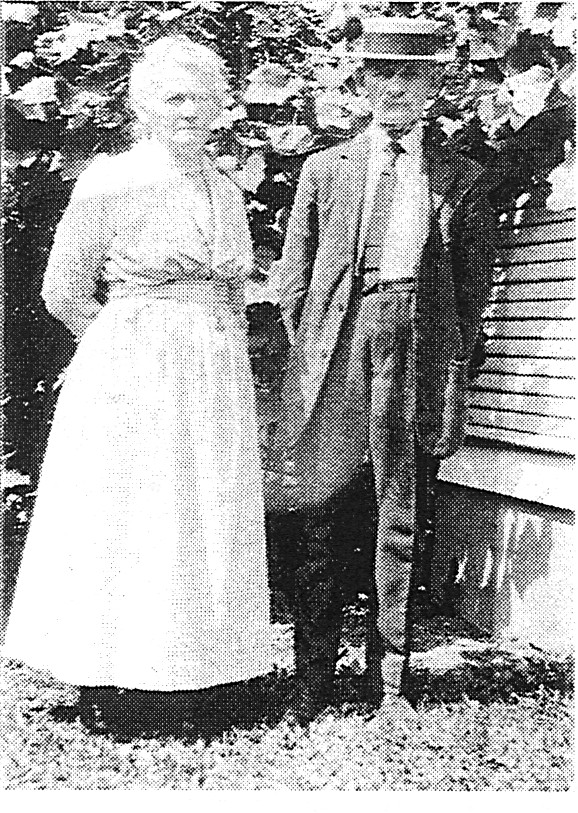
The youngest of the five children born to Annie and Michael Biewer was christened Annie. Born on June 15, 1853, on a farm near Fredonia, Wisconsin Annie would continue living in Fredonia until 1862 when she was age nine.
Annie Kirchen, her mother, made the soap the family used over a fire in the yard. Young Annie had a scar on her foot which she received by walking barefoot across the coals left after the soap-making.
It was in 1862 that her mother, Annie Kirchen Biewer, died and Annie was sent to Milwaukee to live. She was to be employed by the woman she lived with. The woman mistreated Annie and consequently her life was unhappy there. Annie’s older sister, Mary, came to visit and when Mary saw the situation there, she took Annie away with her. Mary and her husband, Mat Becker, arrived in Alma in 1869 bringing Annie with them. They came as far as LaCrosse by train and drove by team the rest of the way to Alma. Annie was 16 years old.[9]
Footnotes
[1] “History of the Harry Family” 1961, p. 9. That history also had a lineage chart showing Mary Biewer married a Mathias Becker and that they had 10 children: Frank, Regina, Nick, Olive, Fred, John, Henry, Julia, Rosa, and Jackie. The children of George Biewer and Elizabeth Shink are listed as John, Willie, Julia, Frank, Kate, Eva, Mabel, and Louis. The children of Nick Biewer and Susan Becker are listed as Pauline Biewer while George, Mary, John, Theresa, Annie and Frank all have the last name spelled “Beaver”. Frank Biewer is shown marrying Carrie Breitinner.
[2] “History of the Harry Family” 1961, p. 23.
[3] The information that regarding George Biewer’s accident and disability was found at the U.S. Government Archives (Washington, D.C): Union Army Civil War Pension Records.
[4] The government records note a property at W½NW¼ and Lot #1, both in Sec 18 Tp 101 R35 Jacksonville, Minneapolis.
[5] Pension records for Nick Biewer. U.S. National Archives, Washington, D.C.
[6] “History of the Harry Family” 1961, pp. 9-10.
[7] Pension record of Nicklas Biewer. U.S. National Archives, Washington, D.C.
[8] General affidavit of Frederick Boltog and Frederick Betz. U.S. National Archives, Washington,
[9] “History of the Harry Family” 1961, p. 8.