Viktor’s Problem
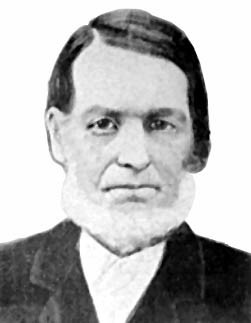
Viktor’s father’s wealth was substantial and Viktor took advantage of this fact. He was a constant source of trouble to his parents. His greatest vice was drinking, and he indulged in it freely. One night Viktor and a friend were at a drinking party and after enjoying themselves a bit too much they left the tavern where they had been drinking and wandered tipsily to another.
They did not enter that tavern but made a noisy disturbance outside. The tavern-keeper came out and tried to get them to move on; but as logic did not seem to get results he became more insistent until a brawl began, which became more enthusiastic until, after being struck or pushed by Viktor, the bartender fell to the ground. Viktor’s pal immediately attacked the downed man with a knife, and stabbed him.
Viktor and his friend were arrested and each drew the same punishment, 90 days in jail or a cash fine. This was satisfactory to the friend, but not to Viktor.
The friend paid his fine and Viktor’s family wanted to pay Viktor’s, but he believed that he was not as much to blame as the man who had used a weapon, and he refused to let anybody pay his fine. As a result, he had to go to jail for 90 days.
At this particular time the jail was so full that criminals had to double up in the cells. Viktor was berthed with two others. They did not prove friendly at first, and regarded him with suspicion and indifference. They went in a corner and talked privately to each other. Viktor was not impressed, and just sat down and smoked his pipe. Prisoners were permitted to smoke if they furnished themselves with tobacco and pipe and flint and steel.
The next day the two broke the ice and came over and asked Viktor why he had been jailed, and he told them the story. They then asked if he would let them take turns smoking his pipe, and he loaned it to them. The next day they repeated the same performance, and after Viktor had relinquished his pipe, he asked them the reason why they had been put in jail. They told him that they had been accused of the theft of valuables, and though they were innocent, were unable to prove their innocence. They explained that they had a great desire to smoke to help them pass the long hours, but they did not know how much bumming they could safely do from Viktor without losing the privilege altogether.
Viktor told them, “I will buy each of you a pipe, and I will keep my tobacco on the table. You can smoke any time you like without asking my permission. Just help yourself whenever you wish to smoke, as long as I am in here with you.”
Almost every day thereafter, the two men asked Viktor how much longer he would have to stay. As the time grew near for Viktor’s departure, they grew more and more nervous, until he had only three more days to stay. Then they approached him again, and one of them told him, “We have a secret we would like to share with you, if you will promise not to tell anyone else.”
Viktor assured them he would not betray the secret, and the spokesman for the two told him, “We are guilty of the crime which we are accused of; we have the money all in gold and safely cached and we will make a deal with you. We will tell you where it is. You can go there, dig it up and take one third of it and re-bury the rest, if you will furnish us with pipe and tobacco as long as we are in jail, or if we die in jail, you can go back and dig up the rest of it and it will be yours.”
Viktor agreed, and was told where the loot was– a place he knew very well. He went there after his release, and though he knew the criminals had buried a kettle full of gold coins (the size of U.S. $20 gold piece, about 1 oz. troy) in that place, he did not dig up the loot. He furnished the two men with tobacco as long as they lived. They both died in prison. So far as is known, the gold still lies buried there.
Viktor went on one of his usual sprees soon afterward, and after drinking enough to make him talkative, he bragged that he knew where the thugs had buried the money. A day or two later two police officers came and arrested him and tried to get him to tell, but he refused. He was thereupon hauled before a judge, but he told the judge, “I don’t know anything about any buried gold, and I can’t help what I say when I am so drunk I don’t know what I’m talking about.” They turned him loose.[1]
Marriage to Maria Berni
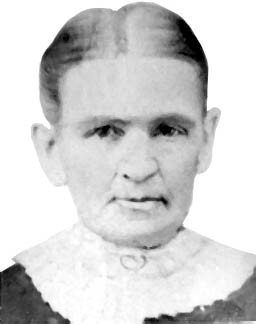
Maria was the daughter of Josef Berni, a farmer from Deitingen and Maria Ziegler from Horriwil,[2] born on April 3, 1826. She and Viktor married on August 3, 1846 in Kriegstetten.
The Family’s Financial Difficulties
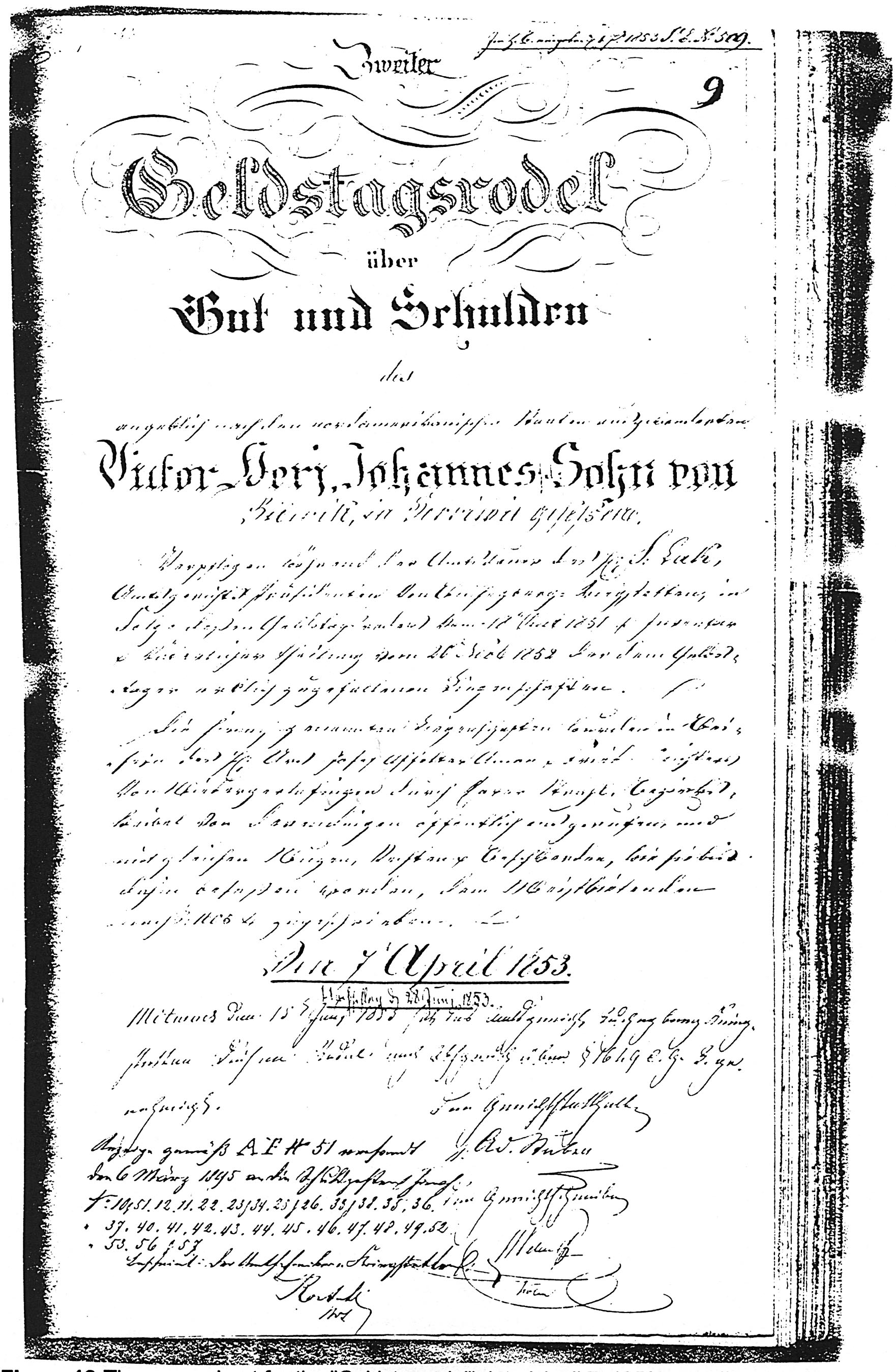
When Viktor was drinking, he would sign notes and mortgages which he was unable to pay, and his father would not. In this manner he lost everything he possessed. For this reason, Johann Heri helped his son Viktor bring his wife, Maria, and their two small sons, Johann and Ferdinand, to America with the hope that in America Viktor would lead a better life. Johann was four years old and his brother Ferdinand (Fred) was two. Another child had died on July 2, 1851.The Staatsarchiv of Solothurn houses many pages of the Municipal Offices of Kriegstetten’s documentation of the “selling by auction” of Viktor Heri’s possessions in 1851 and again in 1853. The entries in the “Geldstagrodel” for December 18, 1851 and April 7, 1853 also indicate that Viktor immigrated to the United States with his family a short time before the first auction on December 18. Both entries list all the possessions and debts of Viktor.[3]
Traveling to the United States
The Viktor Heri family left from the port of Le Havre in France, along with a few other Swiss families and a cross section of other nationalities, to begin a new life in the United States. They crossed the Atlantic on the ship “Minnesota” mastered by a William Allen.[4] The journey would last for about six weeks.
A large whale followed them for a great distance. Sometimes it swan beneath the ship, and everyone was afraid that it might surface underneath the ship and overturn it. But no accident occurred, and finally the whale went away.
One day the sun shone brightly and it was a beautiful day on the ocean. Someone said that this only meant a bad storm was coming; and though everyone else laughed, Viktor took all their boxes and trunks and tied them securely to the deck. As had been predicted, a terrible storm struck down upon them. The boat pitched so violently that at times the passengers were almost on their heads. When at last the storm subsided, everyone’s baggage was in dreadful condition, with only Viktor’s remaining intact.
At one time the ship went off its course for two days. When the captain discovered this, he unmercifully beat the man who had been steering, for making this mistake.
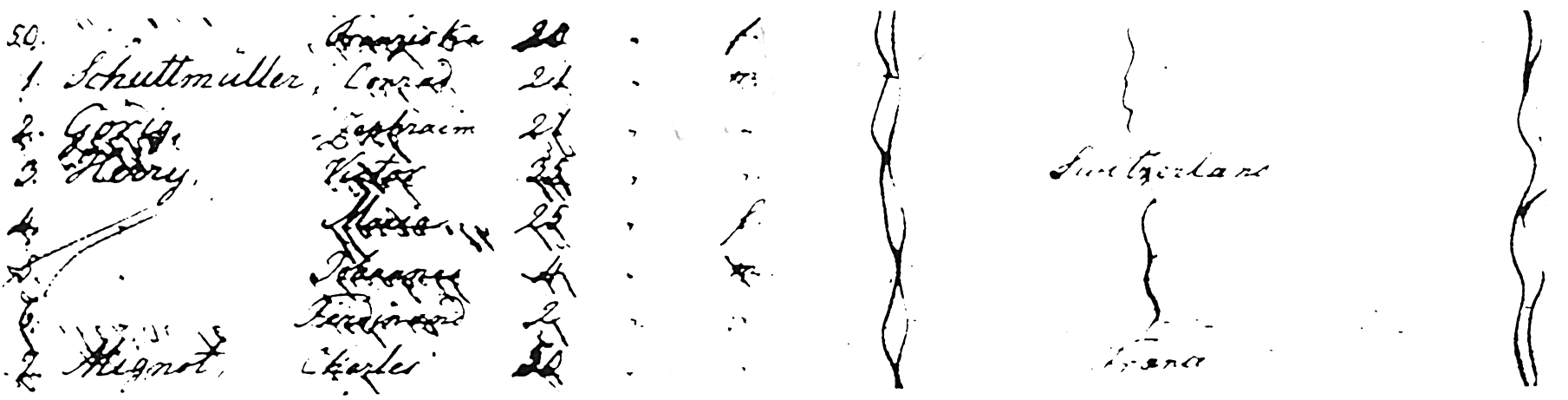
The boat landed at New Orleans, Louisiana.[5] The family remained there for a while (perhaps Viktor’s brother Hieronimus was in New Orleans at the time) and then went up the Mississippi River to Dubuque, Iowa. Although only four years old at the time, Johann Heri could remember seeing trees loaded with unknown fruit hanging out over the water as they rode up the river on a steamboat. At times they were so close that he could almost reach out and gather the fruit as the boat went by.[6]
At Dubuque, Iowa
The family lived at Dubuque for several years. A daughter, Annie, was born there. There was no possible way to obtain milk and Mary had no milk, so Annie was raised from birth on a substance called “pap,” made from flour and water. Annie grew to be a healthy woman and lived to be 78 years old.
While at Dubuque, Viktor went into partnership with another man to dig for lead. The two men worked for a long time and had a large hole dug, but they failed to find lead. They gave up in despair, but decided that no one else should profit from their labor, so they filled the hole with rocks. Not long afterwards, another man cleaned all the rocks out of the hole, dug a few feet and found lead.[7]
Death of Viktor’s Brother, Hieronimus Vincent
While the family was living in Dubuque, about the same time as Johann Heri’s death in Switzerland, Viktor received the message from a New Orleans lawyer that his brother, who had become a wealthy importer, had been killed by his wife. The lawyer stated that if Viktor would come to New Orleans, he could claim his brother’s estate, which was valued at some $80,000. Viktor never tried to claim the money, probably because he was so terribly poor he could not afford to pay the fare to New Orleans, and his family needed him so desperately that they could not have survived if he had not been there to provide for them while establishing his claim to the estate.[8]
It is not clear what Hieronimus imported that made him so rich. Swiss passport records show that Hieronimus actually traveled to the United States on at least three occasions and his occupation is listed as “clockmaker.”
Settling Near Alma
In 1856, the family came farther up the river and settled on an island six miles south of Alma, which is still known as Harry’s Island. The island where they first lived remained in the possession of the family until the 1930’s, when it was taken over by the government because of the nine foot channel development of the Mississippi River.
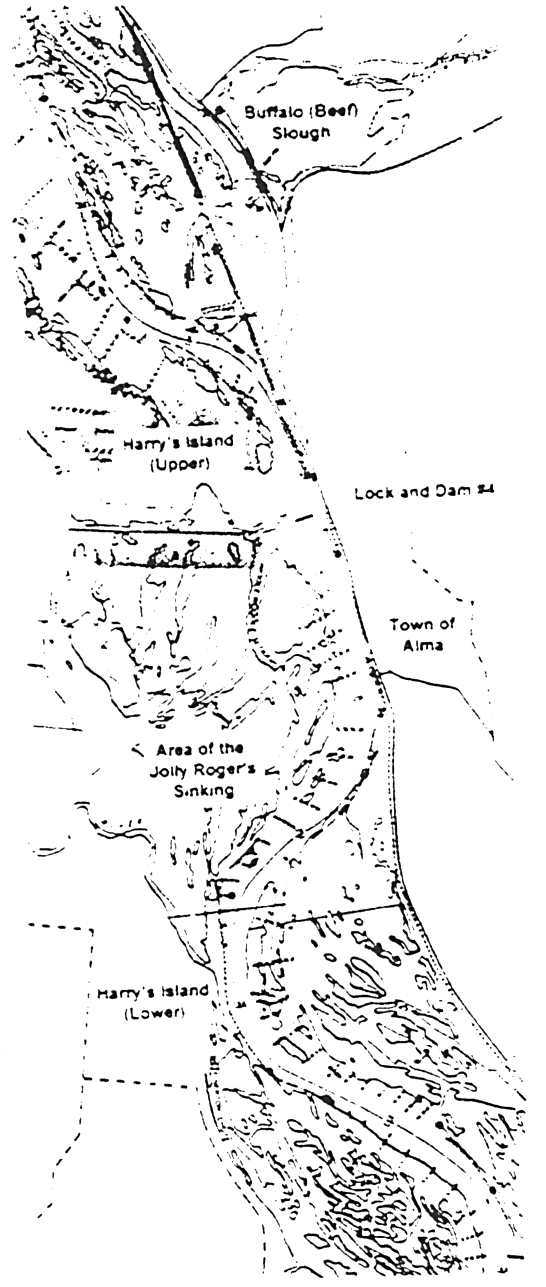
There are a couple of reasons the family ultimately moved to the area around Alma. Family history holds that Viktor and Mary liked their home near Alma because of the rugged bluffs and cliffs along the river made it much like their homeland. For this same reason, many other people from Switzerland and from the mountainous regions of Bavaria settled there.[9]
The fact that the third settler in Alma was a “Joseph Berni” might be another reason Maria Berni, her husband Viktor, and their children moved to Alma. Berni had moved to “Twelve Mile Bluff,” as Alma was known at that time, from Galena in 1849 after serving in the Mexican War. In both 1857 and 1858, the years following the arrival of the Heri’s in Alma, only Swiss immigrants arrived at Alma.[10]
Joseph Berni was born in Biberist in Switzerland in 1811. He first visited America in 1841, returning permanently in 1847.[11] It is not known for sure if Joseph and Maria were related.
Life on Harry’s Island
One day an Indian came to their log home. He seemed friendly enough. He would look at them, then point his arm straight before him and jump around in a circle and at the same time call out, “Tepee, tepee, tepee.” No one could understand what it was he wanted until he heard some Indians far off. He hurried off in the direction of the Indian village, and only then did they realize he was asking them the direction to the tepees.
Viktor and his family were very poor. The woods were full of wild life, but the family, though they needed food badly, never thought of catching and eating the animals; probably because they were not allowed to do so in the old country. When Johann became old enough to work, he took a job at 30 cents a day and used his earnings to buy a rifle. After that, the family never wanted for food. When they needed flour, Viktor would purchase a sack of flour in Fountain City, and thought nothing of carrying it on his back from Fountain City to his home, a distance of perhaps ten miles or more. The family never ate fish, although the river was full of schools of large buffalo fish, weighing up to 50 pounds apiece. Buffalo County and Buffalo City perhaps got their names from these huge fish.[12]
From Heri to Harry
The family name was changed from Heri to Harry around this time. Johann and Ferdinand were going to school in Trout Creek and the teachers anglicized the name, spelling it the way the children pronounced it. According to Earl Harry, his father John and his father’s brother Fred
were small boys and the teacher was able to convince them that he must be correct as he was a teacher and therefore was an authority and must be correct. It left them with the suspicion that they might have been wrong and not having any preference anyway, accepted the spelling that all of us born later were content to use.[13]
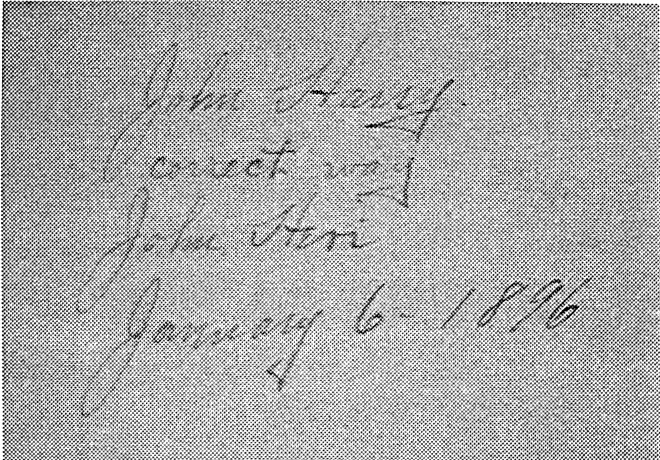
Since the family language was German, the children spoke German at home, and in some cases had to learn English at school. They adopted the English spelling of their name along with the English language.[14]
In fact, in various documents, including the ship manifest from the trip over from Switzerland and Viktor’s naturalization paper, the family name is spelled in a variety of ways.
Life at Alma, Wisconsin
In 1857, the family, consisting of Viktor and Maria, the children Johann, Ferdinand and Anna, moved from the island and located on the Lower Beef River, opposite the mouth of Mill Creek perhaps onto land north of town near the mouth of Iron Creek.[15] Victor looked over all the splendid farm land surrounding Alma, on the bluffs and valleys to the eastward, and finally chose the poorest piece of all, probably because, the land being so poor, there were few trees to clear and they needed garden space at once.
The only communication with the settlers on the Alma side of the Beef River was over a bridge formed by felling a tree across the river, which was perhaps the first bridge built there.
Two boys who died in infancy and two girls, Mary and Louise, were born while the family lived there.[16]
In these early times there were few doctors, and those there were knew little compared to the medical men today. Victor had the ability to make a salve that cured burns in a remarkable manner. The salve had to be used when fresh, so whenever Victor would hear of an accident he would make a batch of salve and walk miles to bring relief to the sufferer. Either through carelessness or because it was harder for people to write down things in those days, the ingredients of the salve were never revealed, and Victor’s knowledge died with him.
The country was full of Indians and was in a primitive state of development, as there were no roads, bridges, railroads, and seldom wagons or horses. The river was the only means of transportation.
John and Fred were sent to school about a mile and a half from home. Instead of going to school, they would stop and play at the neighbor’s. The neighbors could not speak German and the boys’ mother could not speak English, so it was a long time before their prank was discovered.
The boys were brought up close to nature, and had no fear of wild animals. One day John and his mother were out on the river in a canoe when a rattlesnake swam by in the water, and John reached out, picked it up, and put it in the boat. He was unafraid of snakes and would make pets of rattlesnakes, wrapping them around his neck and playing with them. John always said the snakes would not hurt anyone unless they were scared, hurt, or teased.
However, John had forgotten that his mother was not as unafraid of snakes as he was. The snake started for the front of the canoe, toward Mary, who screamed in terror. John reached out with his paddle and pulled the snake closer to him, while the snake, trying to avoid John, kept trying to crawl toward Mary. Finally John got the snake near enough to him so that he was able to pick it up and put it back in the river again. Mary took the paddle away from him, paddled the canoe to shore, and getting out, applied the paddle to John’s rear end with such force and enthusiasm that it was worn out and splintered before she desisted.
When the family lived on the Beef River, a tribe of Indians also lived there. The only playmates John and Fred had were little Indian boys. John and Fred learned to speak their language. Often the squaw would warn the two boys that they should never peek into a tepee, but that they should open the flap wide and walk right in. The Indians said they did not like anyone who peeked.[17]
The hard life of the country, and living so close to nature, exercising the body every day with regular hours of sleep, made super-human muscles in many of the men of early Alma. It was nothing for the men to come to town, buy all their groceries, place the groceries in a sack which they threw over their shoulder and keep it there all day as they went about their business in town. One strong man was known to carry a cook stove over the hills to his home. When he stopped to talk to friends along the way, he would not bother to put down the stove, but kept it on his back all the time.
John Harry worked with wood-cutters. He had a team which dragged the huge logs to the proper places. The strongest man of the day watched John’s team struggling to drag an unusually heavy log, then walked over to the log, lifted it with his hands, and said, “That’s a good load for the horses, all right.”[18]
Victor’s Naturalization
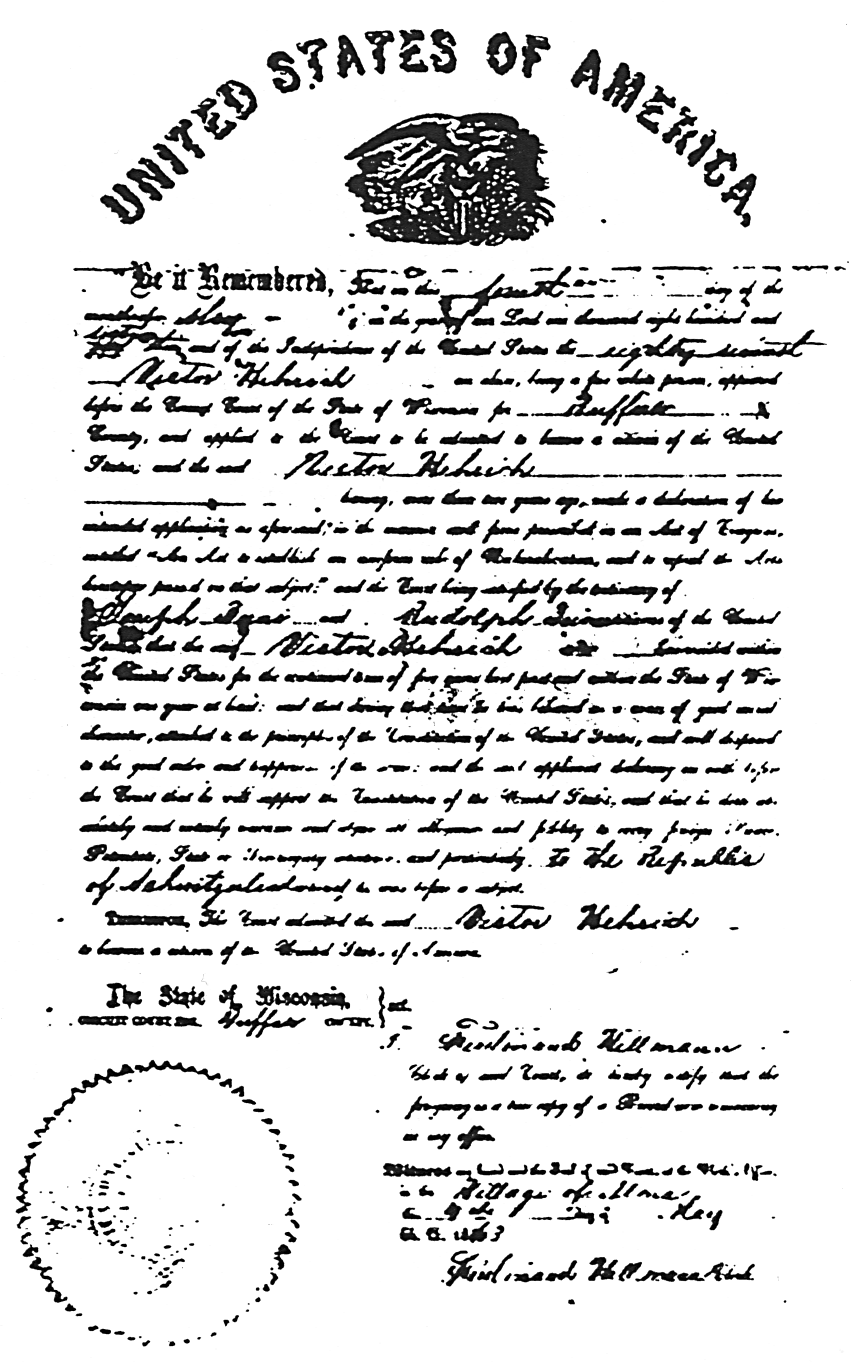
Victor was naturalized on May 4, 1863 at Alma. The documents lists him as “Victor Hehrich.” The clerk completing the document was Ferdinand Hillman.[19]
It has been speculated that this misspelling of the family name was the result of the government official being unable to understand Victor. The Swiss have what is sometimes described as a guttural way of speaking. Someone unfamiliar with this would naturally be unable to spell the name correctly. Misspelled names were a common problem on official papers at this time. The variety of languages people spoke forced clerks unfamiliar with the spelling peculiar to a particular language to spell the way the name sounded.
Because John and Fred, the two living children born in Switzerland, were still under age, they automatically became citizens when their father did. John was almost sixteen years old and Fred was less than a month away from his fourteenth birthday.
Employment
Victor’s farm was in Iron Creek. He was a good woodsman. He cut cordwood on his farm, and his two boys, John and Fred, transported it to town in a canoe each day. They received in exchange one pound of beans, on which the family mainly subsisted.
After Victor and his family settled on the farm in Iron Creek, he worked part of the time as a well-digger for other farmers in the area. Money was scarce, and he was usually paid in produce, which was just as well, since he had not entirely reformed his bad habits which had caused him to leave the old country, and when he did get some money he usually went over to Wabasha and drank and gambled it away.
In one case, he was promised a cow for digging a well, and as the children needed milk, he was anxious to get the cow. There was not enough money to buy shoring material, and not enough time to cut it out in the woods, so Victor sank the shaft without shoring. As the well went deeper and deeper without striking water, Victor became more and more concerned that there might be a cave-in which would bury him and leave his family without a provider. He worked at the bottom of the deep hole, filling baskets with earth, which his son John then pulled up to the ground level with a pulley arrangement and dumped out on the ground.
An experienced well-digger, Victor could tell by the condition of the earth as he went deeper that it was quite likely that the whole thing would cave in on him; and he became more and more worried, not so much for his own safety as for fear of what would happen to his family if he were no longer alive to provide for them, until at last he could not sleep at night for worrying. For three nights he tossed and turned all night, unable to sleep, and then dug deeper in the soft earth the next day.
As John Harry remarked many times later, “We needed that cow bad, but we needed the old man a damned sight worse.” But at last, on the fourth day, the shaft got down to water without a cave-in, Victor got his cow, and the family had both milk and a provider. And Victor could sleep again at night.
John Harry worked in Minnesota an entire summer when only 10 years old. He was paid in geese, which the family was glad to get, as they furnished feathers for all their beds.[20]
Deaths of Victor and Mary Harry
Victor died at age 68 on July 9, 1884 in the Village of Alma. The attending physician, Newton McVey, listed the cause of death as “inflamation.” The record shows his occupation as farmer, and anglicizes his wife’s name to Mary Barney.[21]
The Buffalo County Courthouse in Alma contains Victor’s will. Although the document manages to add a new spelling to the family name, it is a rather simple, pro forma document.
I, Victor Hery, of the County of Buffalo, State of Wisconsin, being of full age, and of sound and disposing mind, memory and understanding, do make, and publish this my last will and testament, in manner and form following, to-wit:
First. I will and direct, that the expenses of my funeral, and all my just debts be fully paid out of my personal estate, as soon as may be after my decease.
Second. I give, devise and bequeath to my wife Mary Hery, all my estate, real and personal.
Third. I hereby appoint my son, John Harry, executor of this my last will and testament.
In witness whereof, I have hereunto set my hand and seal this 18th day of November, A.D. 1883.
Victor Hery (Seal)
The above instrument was now here signed and sealed by Victor Hery, the testator, in the presence of each of us; and was at the same time published and declared by him to be his last will and testament, and we, at his request and in his presence, have severally subscribed our names hereto, as attesting witnesses.
C. Moser, Jr.
Wilhelm Meissner
Annie Harry[22]
Mary would follow her husband in death on September 16, 1894 at 69 years of age.[23] At the time, she was residing above the store in Alma. On the same day Mary died in one room of the house, her son John and daughter-in-law Annie were celebrating the birth of their ninth and final child, Earl Clemmons Harry. The attending physician was Dr. George Seiler of Alma.
Apparently, some notification had to be made to the Swiss authorities of the deaths of Victor and his wife. The archives in Solothurn, the Swiss Kanton where the family had resided for generations, has a number of documents from the United States verifying their deaths. These documents were sent through the Swiss Consulat in Chicago back to Switzerland. Several of them were signed by Theo Buehler, a Court Commissioner at the time.
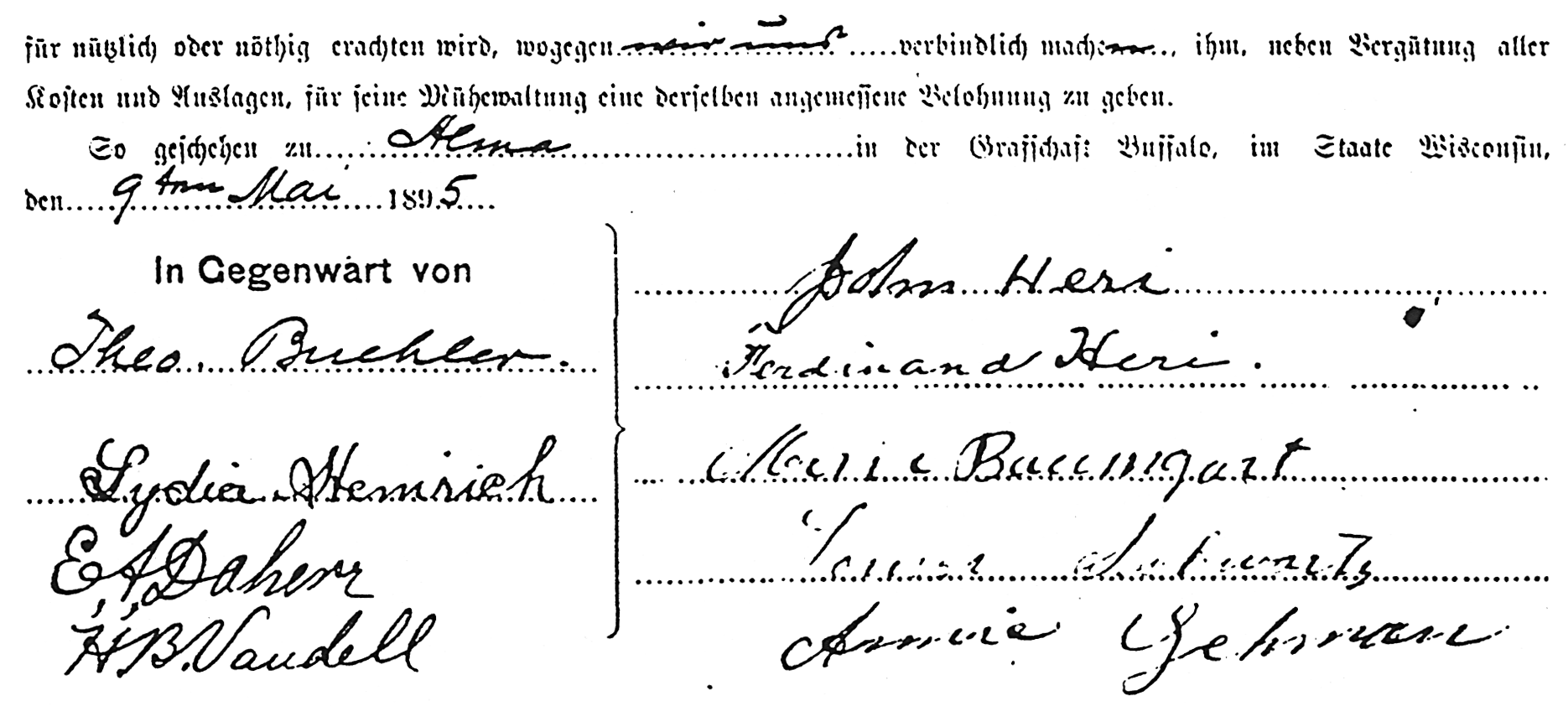
One such document indicated that a lawyer has been given the authority to represent the family. More interesting this many years later though is the information it contains about the family members. It says:
We the undersigned, Maria Baumagart, 34 years old, born in the town of Nelson, Buffalo County, Wisconsin on July 24, 1860 … and Louise Schwartz, wife of Reinhardt Schwartz in Tomah, Wisconsin, 30 years of age, born in the town on Nelson, Wisconsin, the 25th of May, 1864 …; John Heri, 47 years old, born in the month of June, 1847 in the Kanton of Solothurn, Switzerland; Ferdinand Heri, 45 years old, born in the month of June, 1849 in the Kanton of Solothurn, Switzerland…. Anna Lehman, born October 1st, 1855, in Dubuque, Iowa, …[24]
Most interesting of all is that the document concludes with the signatures of all the living children of Victor and Maria Harry.
On April 4, 1895, the Swiss Consul in Chicago, A. Holinger wrote to the Waisencommission of Biberist that “after several contacts with the survivors from Alma, Wisconsin,” he received confirmation that Victor Heri, the son of Johann from Biberist had been dead for 10 years and his wife was now also deceased, that there were five living children and that they live on a farm about 10 miles from Alma. He also requested to know what other documentation in addition to the death certificates he needed to obtain.[25]
Less than two months later, the Chancellor for the Swiss Consulate in Chicago wrote the Waisencommission in Biberist again. He was responding to a letter dated April 17th asking for addition documentation, which he was including with the current letter, pointing out that the name “Victor Harry” on the death certificate was the English spelling for “Heri.” The letter calls for an inheritance payment to the Eidg. Bank in Bern to the hands of a Mr. Engers, a Mr. Cook, and Holinger in Chicago.[26]
Footnotes
[1] “History of the Harry Family” 1961, pp. 34.
[2] Letter from Peter Ingold dated July 3, 1983.
[3] Letter from the Staatsarchiv de Kantons Solothum dated March 17, 1981. “The Geldstagrodel,” which runs approximately 50 pages, most of them double sided, is in the Steatsarchiv des Kanton Solothurn.
[4] Archives of the United States, Washington, D.C
[5] The date of the family’s arrival in the U.S. is unclear. The family history states the boat landed in New Orleans on February 2, 1852 (“History of the Harry Family” 1961, p. 4). However, the ship’s manifest is dated July 3, 1852 which is probably the day following the actual landing.
[6] “History of the Harry Family” 1961, p. 4
[7] “History of the Harry Family” 1961, p.5.
[8] “History of the Harry Family” 1961, p 5. There are some difficulties reconciling this 1961 family history account of Hieronimus with available documents! Swiss passport records show entries on June 8, 1860 and August 10, 1869 for Hieronimus. It is also noteworthy that Viktor and his family were already in Dubuque a mere three months after arriving in the United States. One would think they would have spent some extended period of time with Hieronimus, their sole relative in America, especially since he supposedly lived in New Orleans, their port city. Earl Harry (born: 1894), the family storyteller, once told this story with the added detail that the woman who killed Hieronimus was not his wife but his girlfriend. This would seem to make the story of Viktor being contacted to claim the inheritance more logical. However, so far, no record of the killing has been found and no record of such an inheritance has been established.
[9] “History of the Harry Family” 1961, p.6.
[10] Anderson-Sannes, Barbara, “Alma on the Mississippi 1848-1932” Alma, Wl: Alma Historical Society, 1980, p. 7.
[11] Anderson-Sannes, Barbara, “Alma on the Mississippi 1848-1932” Alma, Wl: Alma Historical Society, 1980, p. 93.
[12] “History of the Harry Family” 1961, pp 5-6.
[13] Letter from Earl Harry to Lawrence Harry, dated March 12, 1980.
[14] “History of the Harry Family” 1961, p.5
[15] The 1961 family history talks about the family settling at Mill Creek while the Alma Historical Society’s book, Alma on the Mississippi talks about them at iron Creek. A letter dated February 6, 1982, Eva B. Harry says “Earl Harry could not remember the Heri’s living in Mill Creek but his Grandpa bought a poor piece of land, 40 acres, in the Badlands near Fleukigers from Eli Jamiesons folks. That is an extension off Iron Creek. Later the Harry’s bought 150 more acres of land in Iron Creek Bluff, that bordered on what they already had. They never farmed it so later sold it to the Jamiesons.
[16] “History of the Harry Family” 1961, p. 6.
[17] “History of the Harry Family” 1961, p. 6-7
[18] “History of the Harry Family” 1961, p. 23.
[19] A copy of Victor’s naturalization was found in the safe of the Harry Store when the store closed in November 1969. Several photos were taken of it at that time. Unfortunately, the document is severely creased, not allowing for a very high quality picture of it.
[20] “History of the Harry Family” 1961, p. 23
[21] From Volume I, page 113 of the “Death Registry.” A copy of this document was first obtained from the Staatsarchiv des Kanton Solothurn although it is a Buffalo County, Wl record and can be seen at the Buffalo County courthouse in Alma, Wl.
[22] Will of Victor Hery located by Chris McCabe in the Buffalo County Courthouse in Alma, WI in June 1995.
[23] From Volume 2, p. 103 of the “Death Registry. A copy of this document was also obtained from the Staatsarchiv des Kanton Solothurn although the original is at the Buffalo County courthouse in Alma, WI.
[24] Document dated May 9, 1895 at Alma, WI and obtained from the Staatsarchiv des Kanton Solothum.
[25] Transcribed copy of the a Swiss Consulate document dated Chicago, 4 April 1895. Transcribed by Peter Ingold, 1983
[26] Transcribed copy of a Swiss Consulate document dated Chicago, 28 May 1895. Transcribed by Peter Ingold, 1983.