Earliest Records Found
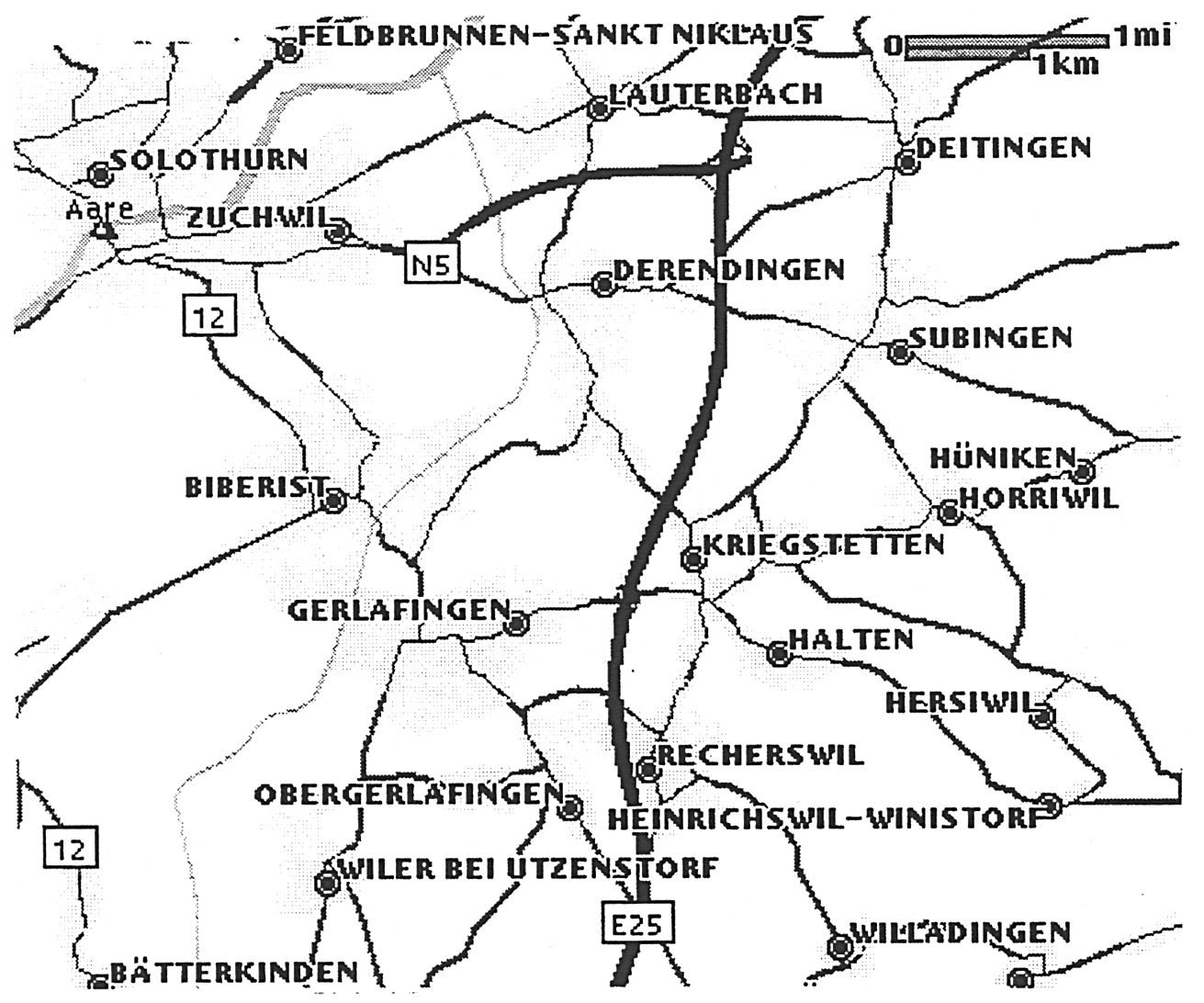
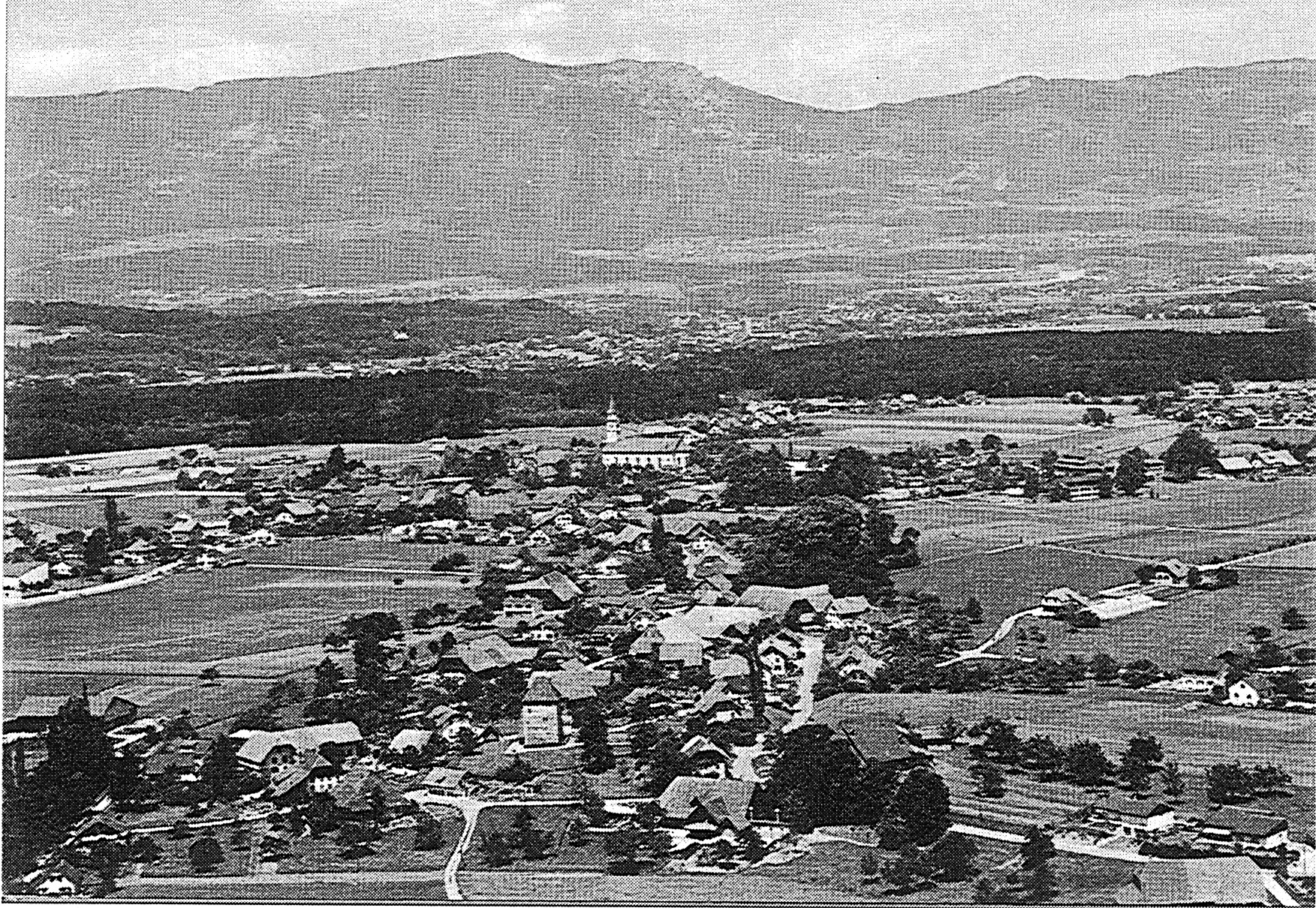
Church records for the town of Biberist in the Swiss Kanton of Solothurn date from 1602. Two Heri’s, Johann and Thomas, are mentioned in these documents although the relationship between the two has been lost in time. The entry for the marriage of Johann Heri to Chrischo (Christine) Wäber on February 22, 1623[1] begins the documented history of our branch of the Heri-Harry family. The year 1998 is the 375th anniversary of their marriage.
The name “Heri” can be found in much earlier Swiss documents. The oldest, dating from 1365, records a “Ruodin Herrin” from Reiben (near Büren or approximately 20 kilometers from Biberist) as a guarantor.[2] The Ratsmanual from Solothurn contains the notation that a Heinzman Heri and his children were freed from bondage in 1472. The cost was 40 gilders. Another document records that Heinzman and his eight sons and three daughters received the civic rights of Bibersch (the old name of Biberist) in 1474.[3]
A link between Heinzman’s family and that of our ancestor, Johann, has not been established. However, because no other Heri’s are known in that time and the fact that Heinzman and his wife had eight sons, it is a real possibility that all the branches in the Biberist area descend from him.
The marriage of Johann and Chrischo produced seven children. The fourth child, Claus married Maria Bollinger on April 20, 1656. That marriage resulted in 11 children. Their eighth child, Urs Niklaus married Maria Barbara Lüthi and they had five children. So continues the history of our family until now, at the end of the millennium, we have begun the 13th generation of descendants of Johann and Chrischo’s descendants. A total of 728 names, including 482 direct descendants, are recorded here. Their lives form a diverse and rich story of the last 375 years.
The Migration of the Heri Family to Derendingen and Gerlafingen
In the 18th century, the descendants of the Heri Family, who had resided in Biberist since the 1400’s, migrated to the towns of Derendingen and Gerlafingen.[4]
On January 1, 1739, Jakob Heri, a leather worker from Biberist, married Ursula Strausak whose family also resided in Biberist. On September 28, 1740, their first child was baptized in Derendingen. Subsequent records show that nine other children from this family were born in Derendingen. However, after the birth of the second child, Ursula died. Jacob married again on February 22, 1745. His second wife was Anna Maria Schneider. The Heri’s residing in Derendingen today are descendants from Jakob.
Between November 11, 1742 and December 13, 1745, Hans Heri and his wife Anna Maria Brunner and their children settled in Niedergerlafingen. Records show that Johann Joseph Heri and his wife Anna Maria Steiner also moved to Niedergerlafingen with their children. Later records show that in the 1800’s branches of the family are also present in Ammannsegg and in the 1900’s in Lohn, Solothurn, Zuchwil and Zurich. Each of these branches find their roots in the Biberist Heri’s.[5]
Behind the Names
Because much of the family history is dealing with a time period long removed from our own and a culture that is perhaps just as distant, a few words about names might be in order. In your reading of this history, you will encounter many of the same names used for different people. This repetition lead one 20th century family member to wonder if there was an explanation or if they just lacked creativity.
Sometimes there is a logical explanation. The names Urs and Viktor were and still are popular first names because they are the patron saints of the cathedral and town of Solothurn.[6] Of course, Maria (Mary) and Josef (Joseph) would be popular in a Christian area because they are the names of the parents of Jesus. Johann (John), Niklaus, and Anna were all saints whose lives would have been very familiar to the Swiss.
In several instances, the name of a deceased child was given to a newborn in the same family leading to some confusion unless birth dates and death dates are considered. There are attempts to honor a family member by passing his or her name on to a newborn. The practice resulted in a very small pool of names being used over and over.
It was also a common practice for the profession or job a person held to become their nickname. Jonas Heri (born: 1860) was employed as a “kutscher” (coachman) and apparently well known as such. As a result, his name is sometimes listed on records as “Jonas Kutscher Heri.”
The official documents might have recorded the routine business matters of that day. Today they are often clues into the life of the family and its members. One document notes the character of Josef Heri, the saddler (harness maker), “to be of good stature and strong order.” In 1591, the city government made the decision “that the inn-keeper Felix Heri should receive a license for his business … so that he can pay his debts.” Unfortunately, on May 16th of the following year, the Ammann (city official) demanded that Felix pay the 100₤ fine levied against him.
Demonstrating the family characteristic of persistence, Mariz Heri is recorded to have continually asked the government for permission to sell food at his inn. He gradually wore down their patience but did not receive the permission. Instead, in 1599, there is a notation that if Mariz ever comes back to ask again, he should be put in jail. Almost a century later, on November 22, 1692, Ludwig Heri, taking his turn as innkeeper, sold it for 6200 crowns and 10 doubloons.[7]
The names of towns are often significant too. In the 4th century, the Germanic tribe of the Alemanni immigrated into parts of Switzerland. They kept their German gods and culture. Villages with names ending in “-ingen”, like Dietingen, Derendingen, Gerlafingen, etc. were the creation of the Alemanni.[8]
Other prefixes and suffixes on town names are keys to understanding the story of the area. The “-wil” ending on names of places (such as Horriwil) means “country-house” or “farm”. It is derived from the Latin “villa.” Many times there are references to “Obergerlafingen” (Upper Gerlafingen) and “Niedergerlafingen” (Lower Gerlafingen). In 1939, the larger of the two villages, Niedergerlafingen omitted the prefix and became “Gerlafingen.” Likewise, occasional reference is made to “Oberbiberist” or “Unterbiberist” as distinct from Biberist.
More recent books and documents on the Solothurn area refer to the “Wasseramt.” This is the official designation adopted in 1987 of one of the 10 districts (Bezirk) of the Kanton of Solothurn. It translates “the district with much water.” Earlier, the area was officially known by the name of its most prominent village, “Kriegstetten,” although the people traditionally called the area “Wasseramt.”
In 1466, the town of Solothurn bought the dominion of Kriegstetten and the “merciful lords” governed it until the French invasion of 1798. However, it was only in 1831 that the people of the Wasseramt have had basic human rights and freedoms.
With the Wasseramt being a very Roman Catholic area, it is important to have an understanding of the Catholic churches in the area. The church at Biberist is mentioned in documents dating from 762. Its original site was on the bank of the river “Emme”. In 1480 it was built on the present site. The other churches in the Wasseramt are mentioned in documents of the 13th century (e.g. Deitingen and Kriegstetten in 1275 and Zuchwil in 1300). Each parish served people from a number of villages, sometimes maintaining a chapel in the particular town. Kriegstetten was large, serving Derendingen, Obergerlafingen and Niedergerlafingen, Recherswil and Horriwil. The church at Derendingen was detached from Kriegstetten in 1933 while Gerlafingen only became an separate parish in 1956.[9]
Das Reislaufen in Switzerland and the Civil War Service of Hermann Heri
The practice of mercenary service in foreign armies (das Reislaufen) had a long tradition in the Swiss Confederation. The Swiss Wars had produced a famous Swiss infantry which sold its services and history records the heroic military skills of the Swiss throughout a broad span of European Renaissance history. Although such mercenary military service was officially forbidden by the Swiss government, the country’s young long continued to be a valuable and dependable military resource for foreign powers.
Recruitment of the Swiss soldier was not a very difficult sell. Swiss mercenary service, particularly with the French army, was a popular form of employment. Swiss families knew that a great deal of wealth could be gained through their involvement in this “business”. The benefits often came at a high price in blood however.
The Heri Family participated in the tradition of soldiering for a fee. The family name “Heri” derives from the Alemannic “Herin.” Herin is similar to the word for fighter or striker. At times, the family paid a very high price for this tradition. Erhart and Ullin Heri as well as three other young people from Biberist died in 1488 during military service in a foreign country. In 1793 the High Mayor, Johann Jakob Heri in Oberbiberist received a letter from France informing him that his son, Johann Joseph (born: February 22, 1756) had died “a glorious death in battle against the rebels.” He was killed at the Battle of LeMans during the French revolutionary war. His military career in the French service is known to have dated from at least 1780. His brother Johann Jakob (born: February 10, 1760) was also serving in France in 1790 although his fate is not known.
Two sons of Johann Jakob Heri, Governor of Bleichenberg, died in foreign wars. Claudius (born: May 4, 1794) lost his life in French service on May 23, 1826 in Madrid. His brother Johann Jakob Jodocus (born: December 14, 1810) died on April 25, 1835 while serving as a “grenadier” in Naples, Italy.
Not a mercenary in the traditional sense, Peter Josef Hermann Heri [10] from Biberist served in the Union Army during the Civil War in the United States. Born on July 4, 1840, sharing a birth date with what would become his adopted country, Hermann was one of four children born to Johann Jacob Heri (born: April 17,1806) and Magdalena Maria Müller (born: December 22,1813). On September 28, 1847, one month before the birth of their last child, 47 year old Johann Jacob died of tuberculosis. About 8 months later, Johann’s father, 78 year old Urs Josef, died. Magdalena was now alone in her responsibility to raise a family of four children, the oldest, Hermann, being 8 years old.
From the time of his father’s death, Hermann helped his mother support the family. At age 15, he immigrated to the United States and continued to send his mother money. His passport application records that he was not yet 1.5 meters (4’10”) tall, had brown eyes, and dark brown hair. Arriving in New York, Hermann first tried his hand as a carpenter’s apprentice. Unable to earn a living wage, he began working as a clerk in a store. However, late in the summer of 1862, Hermann became a Union Soldier in the American Civil War.
When Hermann enrolled in the Army on August 27 at Rochester, N.Y., he expected his tour of duty to last three years. On September 13, he was mustered in as a private in Company “C” of the 140 Regiment of the New York Infantry. At the time he joined, he was described as “five foot six inches, florid complexion, brown hair.”
Not much more than glimpses of Hermann’s military service can be gained from his official records. As late as the 1930’s his relatives in Switzerland still had a letter Hermann had sent from the United States. However, this letter has since been lost. Since no other correspondence is known to exist, we have to rely on his official military records. Hermann’s July/August 1863 roll card noted that he was “sick in McDougall Hospital, NY since July 2/63”. McDougall was located at Fort Scuyler. The spelling of his name had changed to “Herry.” Another roll card, from September/October, 1863, notes he was “absent sick Oct 26th.” On Hermann’s May/June 1864 roll card, in the space set aside for “remarks,” it simply says “Killed in action May 5/64”. [11]
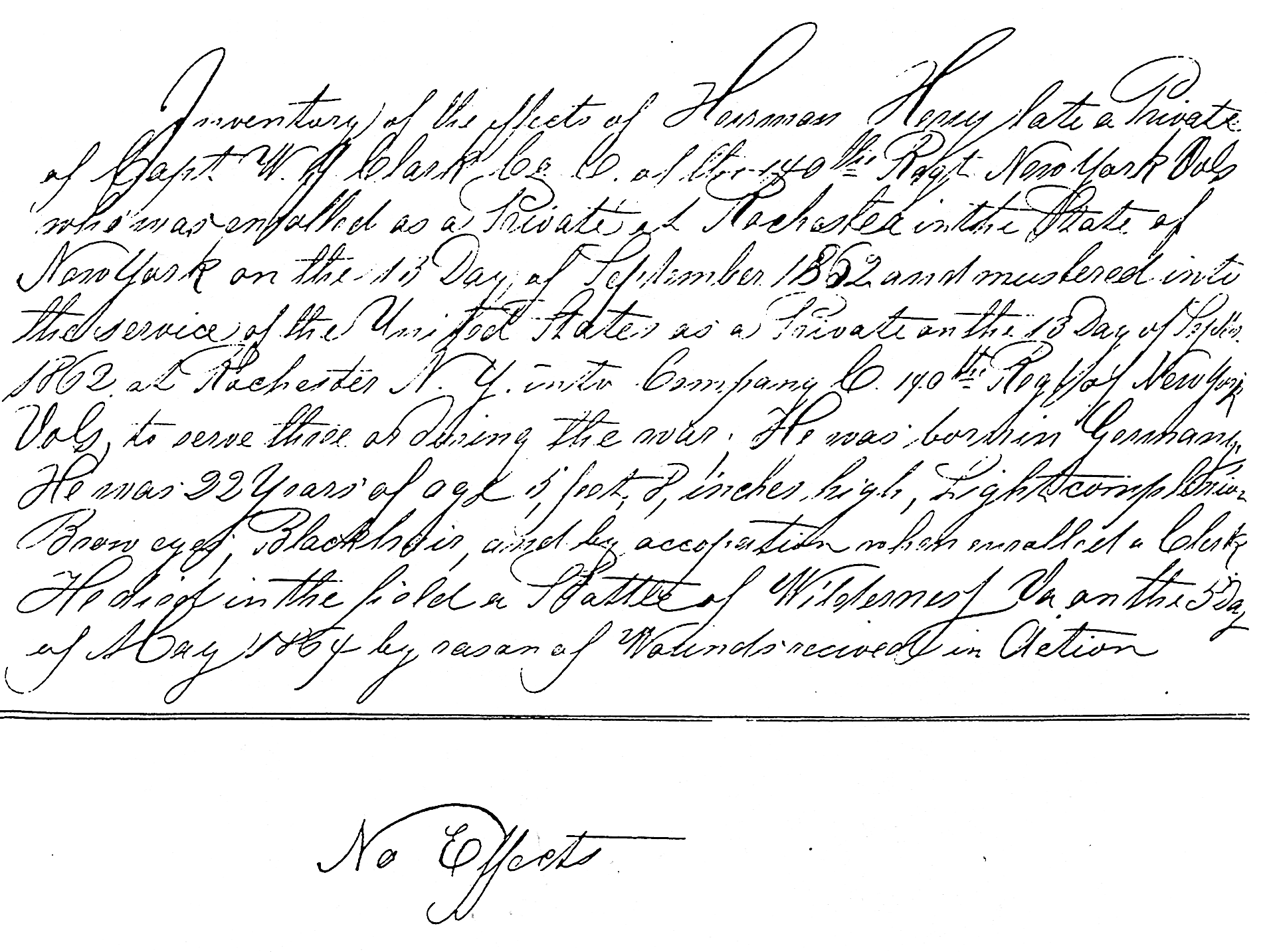
Hermann’s death came in the battle at Wilderness in Virginia as the result of a “gun shot wound of the head.” Despite the tenacity of the regiment, almost one-third of its men were lost in the Wilderness. On June 30, 1864, almost two months after Hermann’s death, Capt. W.J. Clark, camped near Petersburg, VA., finally found time to write up the required “Inventory of the Effects,” for Hermann. Captain Clark notes that Hermann had no personal effects with him at the time of death and then writes that the 22 year old died “by reason of wounds received in action.” This was the same W.J. Clark that had enrolled Hermann in the army back in New York in August 1862. Hermann’s “Army of the Potomac” certificate of death, lists him as a member of Company C of the 140th regiment of the Volunteers, 1st brigade, 2nd division, 5th Corps. Another document dated following his death described him as “age 22, five foot eight, light complexion, brown eyes, black hair.” He had grown 10 inches in height in the almost 7 years he lived in the United States.
Swiss documentation records that Hermann died without having married.[13] He had continued to support his mother back in Switzerland as he had since the age of eight. Now that he was dead, a battle began to secure a pension from the government of the United States of America for Magdalena in Biberist. A letter dated June 26, 1866 from the Regierungsrat of the Kanton of Solothurn pleads for continued support explaining that Magdalena “received no other support to a great extent and who has lost in the death of her son the only source of support.”[14] Even the head of the Swiss government would get involved in the case. Eventually Hermann’s mother was granted a pension from America and continued to receive it until her own death at age 67 on November 7,1881.[15]
The Heri Family Crests
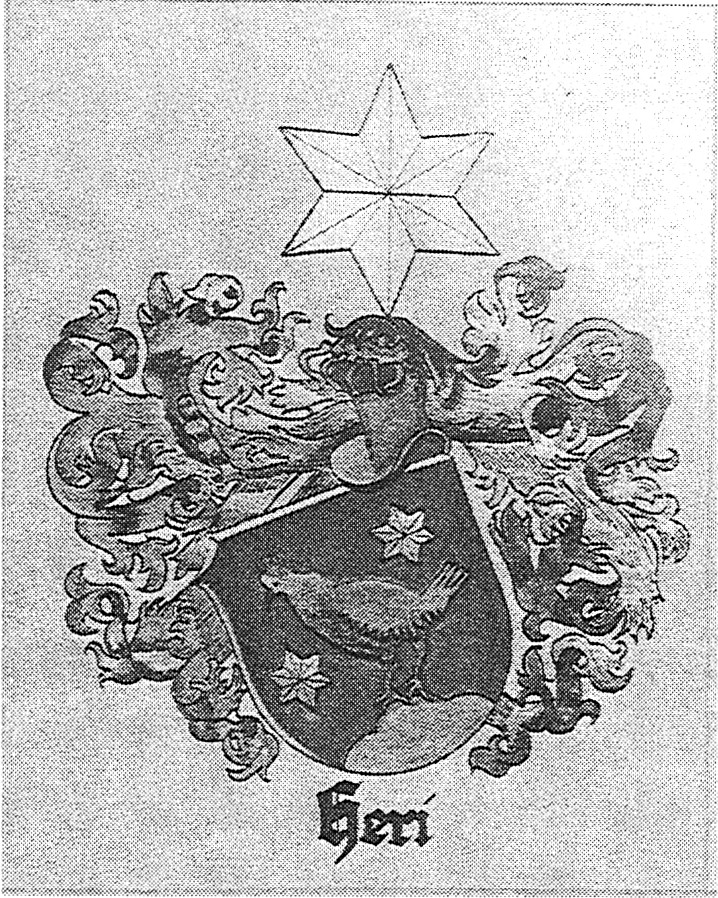
It is the practice in Switzerland that any person can have a family crest, developed just for that person. There is an unwritten law that only the descendants of a holder of a particular coat-of-arms are authorized to use the same one. As a result there are any number of “familienwappen” but not a particular one for the family as a whole. Three such crests from Heri’s were located.
The first shield has the colors of green, gold and red. Above the shield is a prominent six point gold star with one point resting on a soldiers helmet. On the shield itself are two additional gold stars and a red bird (Herrengägger) on a hill. The bird apparently was chosen because its name, when pronounced in the Solothurn dialect, sounds like “Heri.” The same six point gold star appears on the Niedergerlafingen crest. This shield belonged to an Urs Heri who lived in Solothurn in 1620.[16]
The second shield is predominantly blue with some red coloring. On the soldier’s helmet are plume feathers. On the shield is a gold colored ax with a red handle, the symbol of a soldier. The name “Heri” comes from the Alemannic word for “fighter”. This shield is that of a Josef Heri and was created for the family of Elizabeth Heri in 1936. Members of this family have been citizens of Solothurn since 1919.[17]
A third shield has a prominent blue bird (Ridel Baber) with four alternating bands colored gold and red. This was the crest for Franz Josef Heri of Solothurn and dates from 1705.[18]
The helmet is often added to family crest for effect but has no particular meaning or inference that the person served in the military.
Footnotes
[1] The statistical information on many of the deceased members of the Swiss branch of the family comes Elisabeth Heri, Her father had made a chronicle of the family. She was kind enough to allow me to copy this information during a visit to her home in 1982.
[2] Letter from Beat Heri of Zurich (Switzerland) dated October 19, 1989. Beat belongs to a genealogical society and very graciously not only wrote to me about this early documentation but also supplied me with copies of them.
[3] Letter from Beat Heri of Zurich dated March 10, 1989. See Ratsprotokoll, Bd 5, Bl 293,
[4] Fax from Beat Heri to author, dated June 12, 1995.
[5] Pfarrbucher van Biberist, Gerlafingen und Derendingen, sowie das Familiennamenbuch der Schweiz, Auspabe 1989. Various branches of the Biberist Heri’s immigrated to other countries as well. At least one group went to France where the name was changed to Cheryl. We are not the only branch in the United States either. In May of 1997, I received an e‑mail from Jack and Ann Nussbaum of Washington State and Idaho. Through documents sent by Beat Heri of Zurich, we were able to prove that Ann is the gr, gr, granddaughter of Magdoline Haere (Heri) who married Urs Joseph Williman in Biberist. This branch of the family immigrated to the United States in 1868 and lived in Cochrane, Buffalo County, and in Racine, Wisconsin. Another Beat Heri was born in Switzerland and moved to California in the 1950’s where he continues to reside.
[6] The legend of the two saints began in the year 300 A.D. in the southern Swiss region of Valais All the Christian members of the Roman legion were ordered killed. Urs and Viktor managed to escape. They were later captured and held in Solothurn which was a Roman “castrum” (military base) at the time. Urs and Viktor were eventually beheaded and their bodies thrown into the river “Aare. It is said that the two dead men took their heads in their hands and went ashore downstream from the castrum where they were buried. Solothurn is still a place of pilgrimage for people with devotion to these two early Christians.
[7] Ludwig Schmidlin, “Geschichte der Pfarrgemeinde Biberist,” Solothurn: B. Schwendimann, 1886.
[8] The town of Solothurn and the area to the west were occupied by the “Burgundiansn. Around 534, the powerful German tribe of the “Franks” arrived and overthrew both the Burgundians and the Alemanni. The Franks had the goal of introducing the Christian faith everywhere. They built churches and founded parishes in the villages (e.g. Biberist). But Solothum was already a Christian island with its chapel above the grave of St. Urs. Later, in the 96, century, Solothum belonged to the new kingdom of Burgundy and Queen Berta had a new and bigger church of St. Urs built on the hill.
[9] The Catholic church building in Gerlafingen is built on the land where the home of the Titus Heri family stood.
[10] U.S. Government Archives (Washington, D.C.): Union Army Civil War Pension records, Appl #119, 348, Cert #85636. (Index T288, 213) All of Hermann’s records related to his military service referred to here can be viewed at the National Archives in Washington, D.C.
[11] Ironically, on the same day and in the same battle, Edward B. Wirth, serving with a Pennsylvania Infantry was captured and sent to the infamous Andersonville prison camp. Three of Ed Wirth’s nieces (Mayme, Emily and Elizabeth) would marry Harry’s (brothers Frank and John and their cousin Roy) early in the next century.
[12] See the book Nachos of Glory,” published by Time‑Life for a picture of the Zouave jacket of the 140th NY Infantry and its high praise for Hermann’s regiment.
[13] Seckelmeisterrechnungen Bd. 10, Pfarrbucher Biberist, Inventare und Teilungen Kriegstetten. See also the Ratsprotokoll 1865, 574, 42.
[14] Dokumente des Regierungsrates Solothurn dated June 26, 1866.
[15] Beat Heri of Zurich has researched the tragic life of Hermann Hery and recorded it in an article entitled “Hermann Heri von Biberist (1840-1864) und seine Familie” which he graciously gave me a copy of.
[16] Wappenbuch Valentin Brudershaft 1620‑1705 Famiiie ausgestorben.
[17] Letter from Elizabeth Heri to author, dated September 18, 1995.
[18] Wappenbuch Valentin Brudershaft Sol Familie ausgestorben.